
Complete Guide to AI-Powered Exam Proctoring and Skill Verification
The Complete Guide to AI‑Powered Exam Proctoring and Skill Verification
In today’s digital age, the integration of artificial intelligence (AI) is reshaping numerous operational paradigms, including the realm of education and professional certification. AI-powered exam proctoring and skill verification systems have emerged as pivotal tools, ensuring integrity and efficiency in assessments across various sectors. This guide descends into how these systems work, their benefits, and what future trends we might expect.
Understanding AI-Powered Exam Proctoring
What is AI-Powered Exam Proctoring?
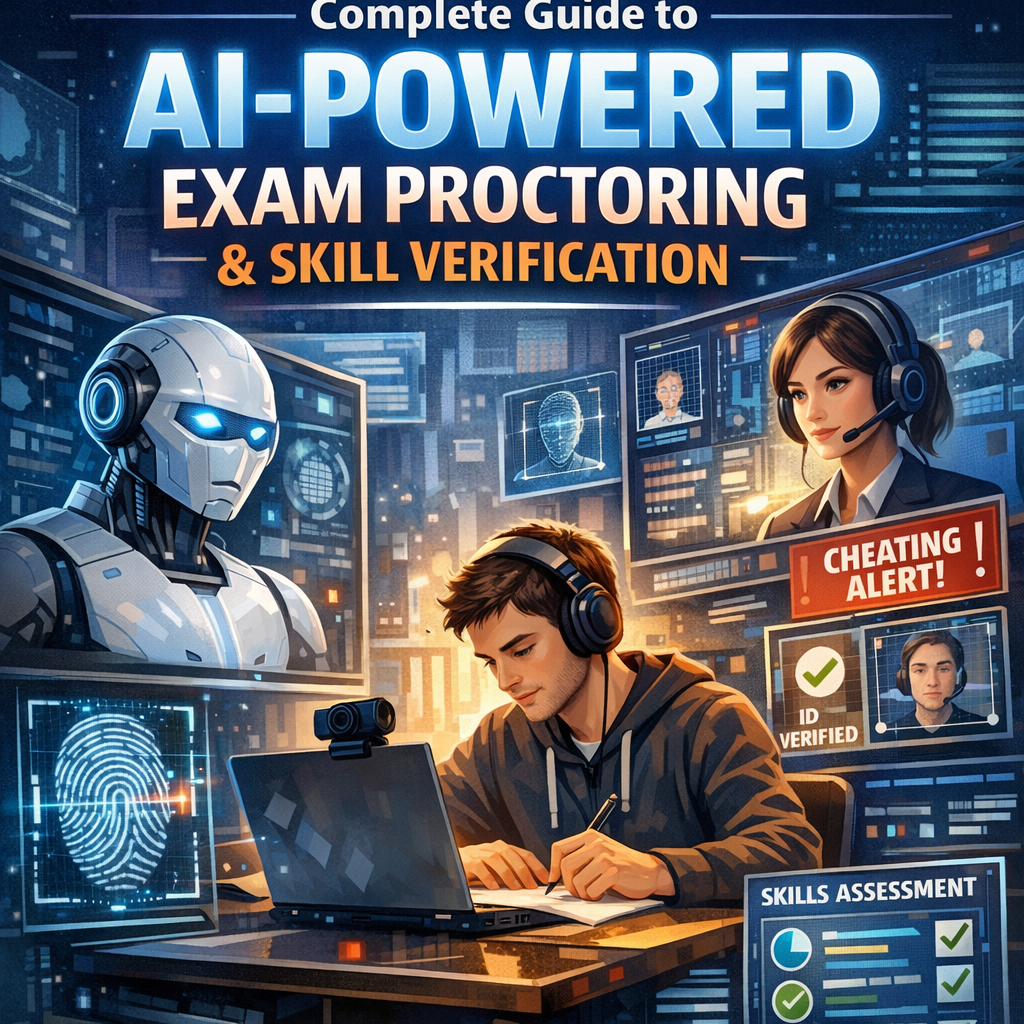
AI-powered exam proctoring utilizes machine learning, facial recognition, and advanced algorithms to monitor test-takers during online exams. This technology ensures that the person registered for the test is the one taking it and helps in detecting any unconventional or dishonest behavior during the examination.
How It Works
- Identity Verification: At the start, the software verifies the identity of the examinee through facial recognition or ID scanning.
- Behavioral Analysis: Throughout the test, AI algorithms analyze the candidate’s behavior for any irregularities such as eye movement, the presence of a second person, or the use of unauthorized materials.
- Flagging and Reporting: Unusual activities are flagged in real-time, allowing human proctors to intervene when necessary. A detailed report is generated for review after the exam.
Benefits of AI-Enhanced Proctoring Systems
Increased Scalability and Accessibility
AI proctoring allows examinations to be securely administered to a much larger number of participants across different geographical locations without the need for physical invigilation.

Time and Cost Efficiency
These systems significantly reduce the logistics and costs associated with traditional exam proctoring by minimizing the need for physical presence and travel.
Enhanced Security and Fairness
With AI-powered systems, the chance of human error or bias is greatly reduced. The technology provides a standardized level of monitoring, ensuring fairness for all examinees.
Advanced Skill Verification Techniques
AI doesn’t just stop at monitoring exams; it extends to analyzing the competencies and skills of individuals through sophisticated evaluation techniques.
Simulation-Based Assessment
AI can create realistic job simulations that are crucial for practical assessments, allowing examiners to measure actual job readiness and operational skills beyond theoretical knowledge.
Continuous Learning and Adaptation
AI systems can adapt to test-takers’ responses, offering different levels of difficulty based on their performance, to accurately gauge their capabilities in a comprehensive manner.
Challenges and Ethical Considerations
Despite the many benefits, AI-driven proctoring and skill verification systems raise privacy and ethical concerns. The extensive data collection and surveillance capabilities necessitate stringent data protection measures and transparency to maintain trust.
Data Privacy
Organizations must uphold robust data protection laws to safeguard sensitive information gathered during AI-monitored exams.
Candidate Experience
The impersonal and high-surveillance nature of AI proctoring might induce anxiety and discomfort among certain test-takers, potentially affecting their performance.
Looking Ahead: The Future of AI in Testing
The future holds promising advancements for AI in the realm of educational and professional assessments. Enhanced AI algorithms will continue to improve in their accuracy, fairness, and adaptability. Moreover, as understanding and trust in these systems advance, wider acceptance and implementation are expected.
Conclusion
AI-powered exam proctoring and skill verification marks a significant leap forward in how assessments are conducted in an increasingly digital world. While embracing this technology, it remains vital to balance innovation with ethical practices and data protection to optimize outcomes for all stakeholders involved. These systems, when managed responsibly, offer a win-win scenario by enhancing operational efficiency and upholding exam integrity.