
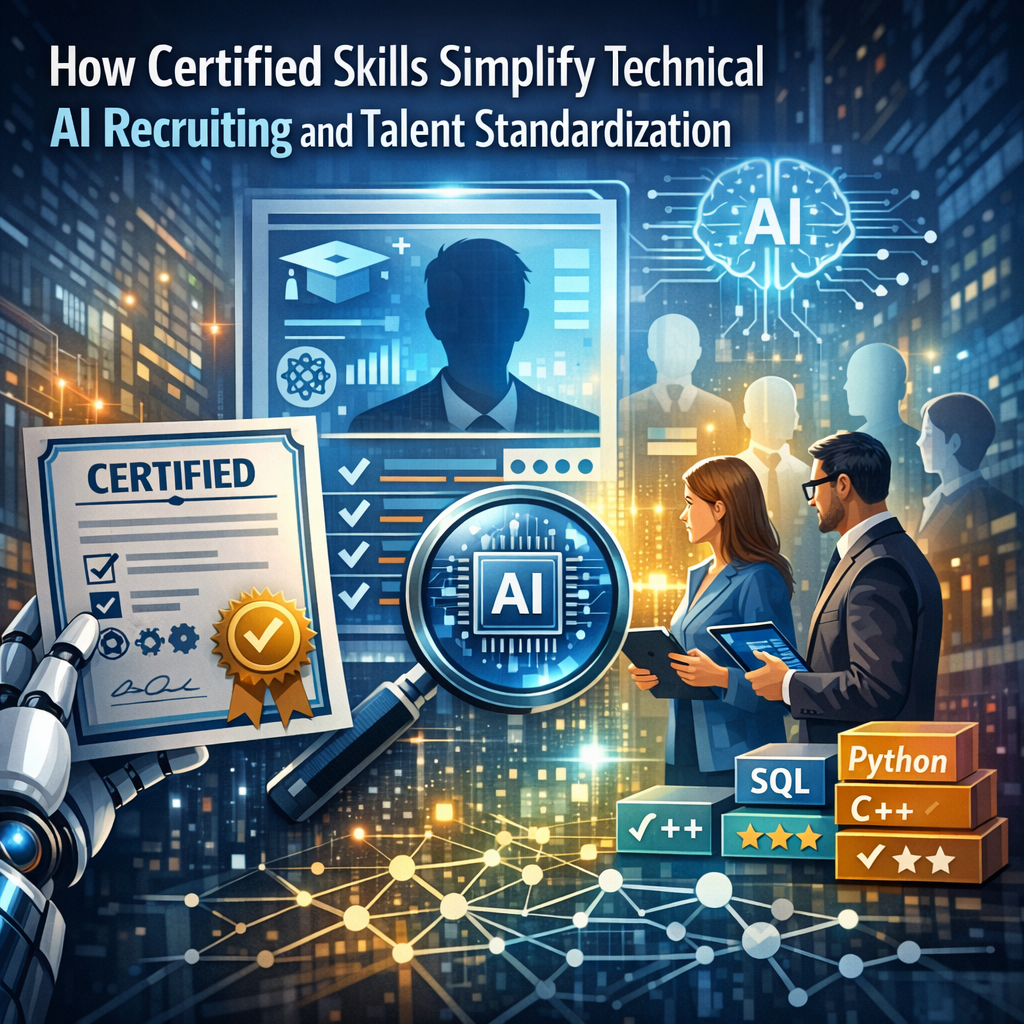
How Certified Skills Simplify Technical AI Recruiting and Talent Standardization
Standardizing Talent: How Certified Skills Simplify Technical AI Recruiting
Hiring for artificial intelligence roles can be difficult to standardize. Job titles such as machine learning engineer, AI researcher, and data scientist often describe very different work, while candidates may list similar tools and skills despite having widely different levels of experience.
Certified skills offer recruiters a clearer starting point. By pairing relevant credentials with practical assessments and structured interviews, employers can make technical AI recruiting more consistent, efficient, and focused on what candidates can actually do.
Why AI Hiring Can Be Hard to Compare
AI roles combine multiple disciplines, including software engineering, statistics, data management, and product development. Two candidates with the same title may have experience in entirely different areas: one may build production machine-learning systems, while another specializes in research or data preparation.

Resumes alone can make those differences difficult to identify. A list of programming languages or AI platforms reveals exposure, but not necessarily proficiency. Recruiters may also face unfamiliar terminology, rapidly changing tools, and intense competition for experienced candidates.
This creates a risk of inconsistent screening. Candidates from well-known companies or universities may receive more attention, while capable applicants with less conventional backgrounds are overlooked.
What Certified Skills Add to the Process
A skills certification can provide evidence that a candidate has met defined criteria in a particular area. Depending on the program, this might include knowledge of machine-learning concepts, cloud infrastructure, data engineering, AI safety, or a specific development platform.
Certifications are most useful when they are:
- Relevant to the role: The credential reflects skills the employee will actually use.
- Based on clear standards: Employers can understand what the certification measures.
- Supported by assessment: Candidates demonstrate knowledge or practical ability rather than simply completing training.
- Current: The material reflects today’s tools, methods, and professional expectations.
A credential should not serve as a shortcut for judging a candidate’s overall ability. Instead, it can help recruiters establish a common baseline and decide what to explore further.
Match Credentials to Role Requirements
Before screening begins, hiring teams should identify the capabilities required for success. A generative AI engineer, for example, may need experience with model integration, evaluation, security, and deployment. A data scientist may need stronger grounding in experimentation, statistics, and business analysis.
Once those requirements are clear, recruiters can distinguish essential credentials from optional ones. This prevents certification lists from becoming rigid filters that exclude qualified applicants who learned through work experience or other routes.
How Standardization Improves Recruiting
Using shared skill criteria helps recruiters assess candidates more consistently. Rather than relying on vague impressions such as “strong AI background,” teams can compare evidence against role-specific expectations.
That structure can support several parts of the hiring process:
- Resume screening: Recruiters can identify relevant training and experience more quickly.
- Interview planning: Hiring managers can focus questions on skills that matter for the position.
- Candidate comparison: Interviewers can use common criteria instead of relying on personal preference.
- Workforce planning: Employers can see which skills are available internally and where development is needed.
Standardization can also improve communication between recruiters and technical teams. When both groups use the same competency framework, discussions become more concrete. Instead of debating whether someone “seems technical,” they can review evidence of model evaluation, coding, data handling, or deployment skills.
Combine Certifications With Practical Evaluation
Technical AI recruiting works best when credentials are one part of a broader assessment. A certification may confirm foundational knowledge, but practical tasks can show how a candidate applies that knowledge to real problems.
Useful evaluation methods include:
- A short, role-related coding or analysis exercise
- A discussion of a project the candidate has completed
- A scenario involving model performance, data quality, or responsible AI
- A structured interview using consistent questions and scoring criteria
Assessments should be proportionate to the role and respectful of candidates’ time. They should test relevant work, not reward familiarity with a company’s interview puzzles. Employers should also consider accessibility and provide clear instructions, timelines, and evaluation standards.
Keep the Process Fair and Flexible
Credentials can reduce ambiguity, but they can introduce bias if employers treat them as mandatory without a clear business reason. Certifications vary in cost, accessibility, and recognition, and not every capable professional has had the opportunity to earn one.
A fair process accepts multiple forms of evidence. Candidates may demonstrate expertise through professional experience, open-source contributions, portfolios, formal education, or practical assessments. Recruiters should also review screening outcomes regularly to identify criteria that may be excluding qualified groups without improving hiring quality.
A Clearer Foundation for Better Hires
Certified skills give employers a shared language for discussing technical capability. Used thoughtfully, they help define role requirements, guide interviews, and make candidate comparisons more consistent.
The strongest approach is not to hire credentials. It is to use them as one reliable signal among several. When certifications are aligned with real job needs and paired with practical evaluation, technical AI recruiting becomes clearer for hiring teams—and more transparent for candidates.