
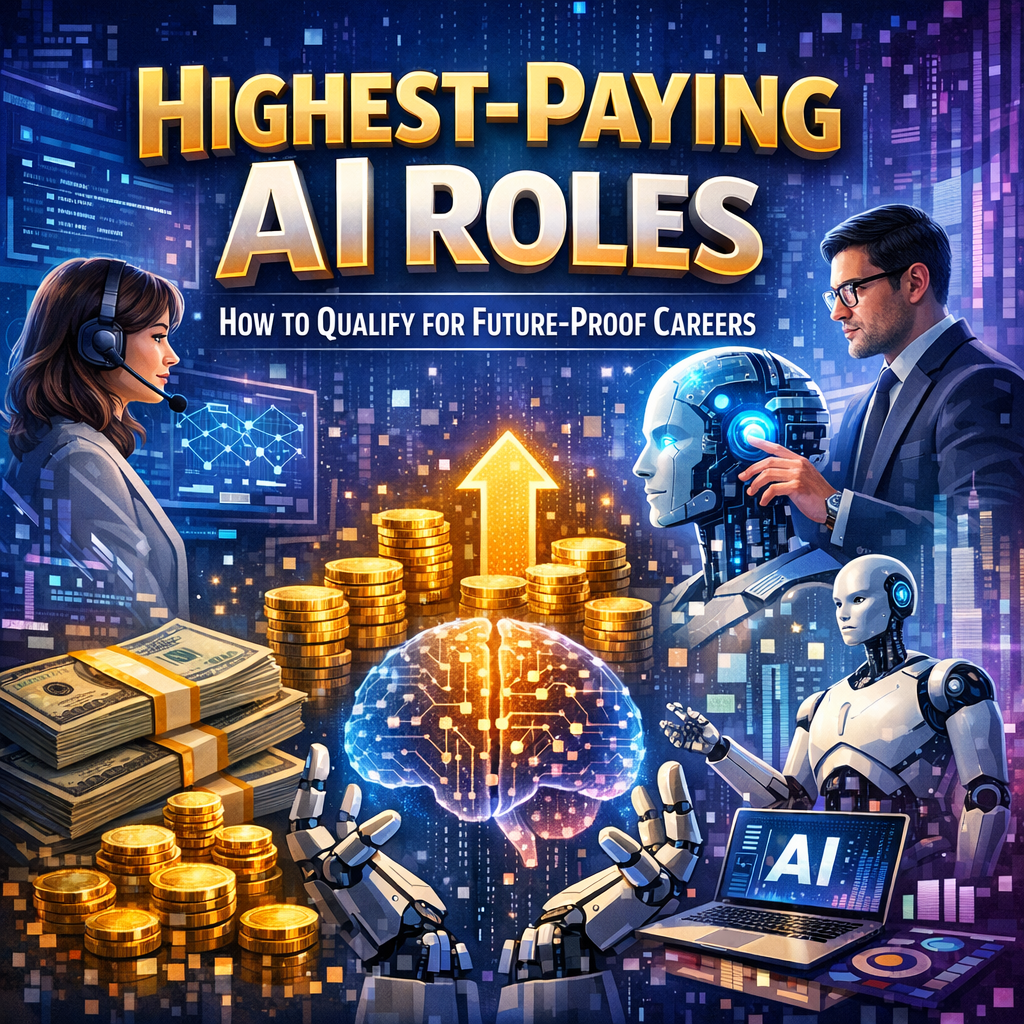
Highest-Paying AI Roles: How to Qualify for Future-Proof Careers
Future-Proof Your Career: The Highest-Paying AI Roles and How to Qualify
Artificial intelligence is changing how businesses build products, analyze information, and serve customers. As adoption grows, so does demand for people who can develop AI systems, make them reliable, and apply them to real-world problems.
The highest-paying AI roles often combine technical depth with scarce expertise. While salaries vary by location, experience, industry, and company size, specialized roles can command strong compensation—especially in major technology hubs and organizations building advanced AI products. The best career path is not necessarily the one with the most impressive title; it is the one that matches your strengths and gives you room to grow.
Highest-Paying AI Roles to Explore
Machine Learning Engineer
Machine learning engineers design, train, and deploy models that learn from data. They work across the full development process, from preparing datasets to monitoring a model after launch.

To qualify, build a strong foundation in Python, statistics, and machine learning. Experience with frameworks such as PyTorch or TensorFlow, cloud platforms, and production software development can help distinguish you from candidates who have only completed coursework.
AI Research Scientist
AI research scientists develop new methods and investigate how to improve existing models. Their work may involve publishing research, running experiments, or creating novel approaches to language, vision, robotics, or other fields.
Many roles require a master’s degree or PhD, particularly at research-focused organizations. A strong portfolio of published work, open-source contributions, or reproducible experiments can demonstrate research ability. This path is most suitable for people who enjoy mathematical problem-solving and long-term investigation.
Generative AI Engineer
Generative AI engineers build applications using models that create or interpret text, images, audio, and code. They may work on retrieval-augmented generation, model evaluation, fine-tuning, or systems that connect AI models to company data and tools.
Useful skills include Python, APIs, vector databases, prompt design, and software architecture. Employers increasingly value engineers who can move beyond simple demonstrations and build secure, dependable applications that work at scale.
AI Architect
AI architects plan how AI systems fit into an organization’s broader technology environment. They consider data pipelines, model selection, privacy, security, cost, and integration with existing software.
This is often a senior role. A typical route includes experience in software engineering, cloud infrastructure, machine learning, or enterprise architecture. Communication matters: architects must explain technical trade-offs to both engineering teams and business leaders.
AI Product Manager
AI product managers decide what AI-powered products should do and how success will be measured. They connect customer needs, technical feasibility, and business goals while helping teams manage risks such as inaccurate outputs or biased results.
A technical degree can be helpful, but it is not always essential. Product experience, analytical thinking, and familiarity with AI capabilities and limitations are especially valuable. A portfolio showing how you evaluated an AI feature or improved a product can support a career transition.
How to Qualify for an AI Career
Build Practical Foundations
Start with the skills most relevant to your target role. For many technical positions, that means programming, statistics, data handling, and core machine learning concepts. For product or governance roles, focus on AI fundamentals, evaluation, responsible use, and business analysis.
You do not need to master every tool. Learn the principles behind the tools so you can adapt as platforms and methods change.
Create Projects That Demonstrate Results
A focused project can provide stronger evidence of ability than a long list of courses. Build something that solves a clear problem, document your decisions, and explain how you tested its performance.
For example, you could create a document-search assistant, compare model outputs using an evaluation set, or build a forecasting tool. Include a readable code repository or case study that describes the challenge, approach, limitations, and outcome.
Gain Experience in Adjacent Roles
AI teams need more than model builders. Data analysts, software developers, cybersecurity specialists, designers, domain experts, and project managers can all move into AI-related work by applying their existing strengths.
Look for opportunities to improve a current workflow, evaluate an AI tool, or collaborate with a technical team. Experience working with real users, data, and constraints can be difficult to replicate in a classroom.
Make Your Career Resilient
AI tools will continue to evolve, so long-term career security depends on more than knowing one model or platform. Develop skills that remain valuable across technology shifts: problem-solving, communication, critical evaluation, data literacy, and responsible decision-making.
The highest-paying AI roles reward people who pair specialized knowledge with practical impact. Choose a direction, build evidence through projects and experience, and keep learning as the field changes. That combination can help turn growing demand for AI talent into a durable, rewarding career.