
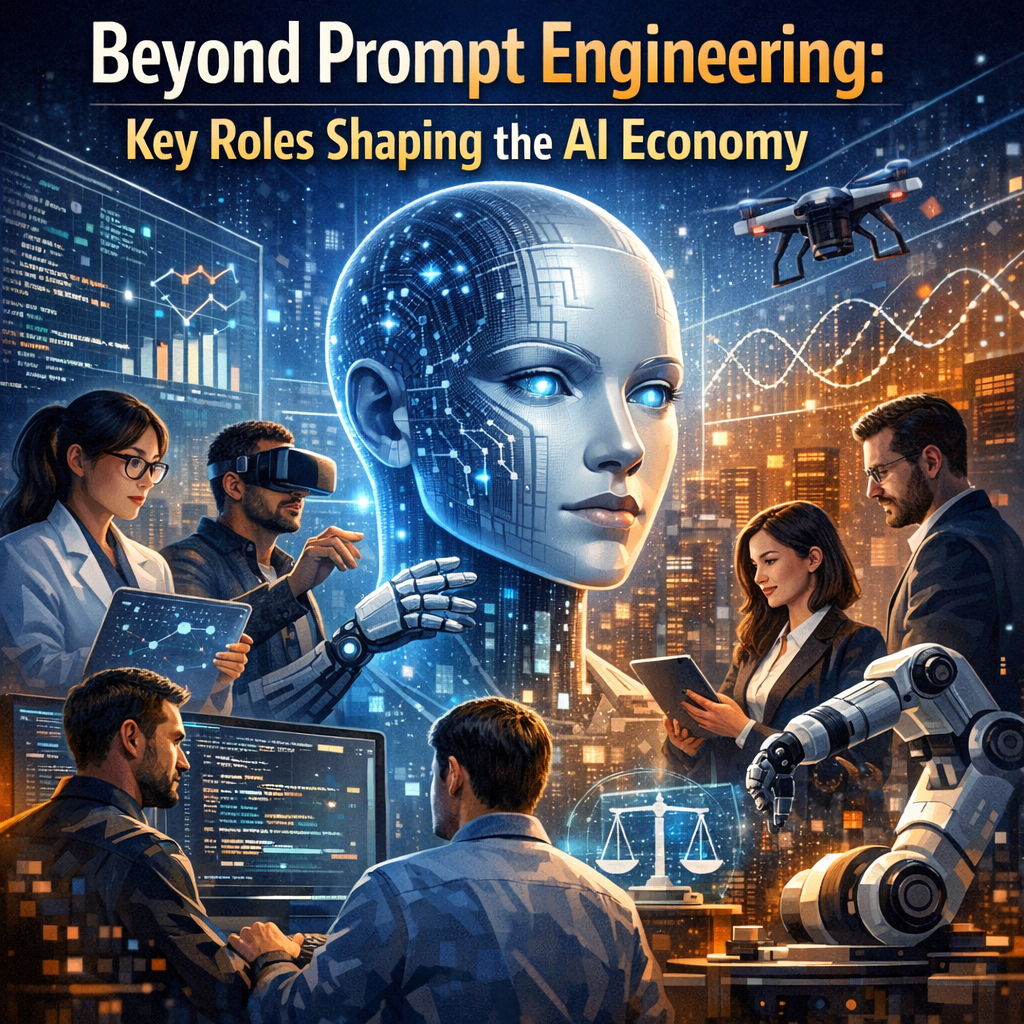
Beyond Prompt Engineering: Key Roles Shaping the AI Economy
Beyond Prompt Engineering: The Roles Shaping the AI Economy
Prompt engineering helped make generative AI accessible, but it is only one part of a much larger shift. As organizations move from experimenting with chatbots to embedding AI in products and operations, they need people who can build, govern, secure, and direct these systems.
The emerging AI economy is not defined by a single job title. It depends on teams that connect technical expertise with business judgment—and understand where AI is useful, where it can fail, and how to make it reliable.
The Technical Roles Behind AI Systems
Machine Learning and AI Engineers
AI engineers build and adapt the systems that power AI products. Their work may include selecting models, connecting them to company data, improving performance, and integrating them into software.

In practice, this often involves more than training a model. Engineers must consider latency, cost, accuracy, and how the system behaves under real-world conditions. A tool that performs well in a demo may struggle when faced with incomplete data or thousands of daily requests.
Data Engineers and Data Stewards
AI depends on usable data. Data engineers create the pipelines that collect, clean, organize, and deliver information to models and applications. Without that foundation, even a sophisticated AI system can produce unreliable results.
Data stewards add a crucial layer of accountability. They help establish standards for data quality, access, privacy, and retention. Their work is especially important when organizations use sensitive customer, employee, or financial information.
AI Infrastructure and MLOps Specialists
Once an AI application is ready, it must be deployed and maintained. MLOps and infrastructure specialists manage the systems that support models in production, including monitoring, updates, security, and computing resources.
They also help teams track performance over time. Models and data can change, so a system that worked well at launch may need adjustments later. Reliable operations turn AI from a one-time experiment into a service people can depend on.
AI Security and Evaluation Experts
AI creates new security challenges. Systems can expose sensitive information, respond to malicious instructions, or behave unpredictably when connected to external tools. Security specialists identify these risks and help build safeguards.
Evaluation experts test models and applications before and after launch. They assess accuracy, bias, robustness, and performance across different scenarios. Their work helps organizations move beyond “it seems to work” toward measurable standards.
The Strategic Roles That Make AI Useful
AI Product Managers
AI product managers translate business needs into practical applications. They help decide which problems are worth solving, what success should look like, and whether AI is the right approach.
That last question matters. Some tasks are better handled by simpler automation or improved processes. A strong product manager weighs potential benefits against cost, risk, and user needs rather than adding AI for its own sake.
AI Governance and Policy Leaders
Governance professionals create rules for how AI is selected, tested, and used. They coordinate with legal, compliance, privacy, and technical teams to address issues such as transparency, accountability, and human oversight.
Good governance does not have to slow innovation. Clear standards can help teams move faster by showing them what is allowed, what needs review, and how to respond when a system causes harm.
Change Managers and Workforce Specialists
AI adoption changes how people work. Change managers and workforce specialists help employees understand new tools, redesign processes, and develop relevant skills.
This role is easy to underestimate. Even an effective system may fail if people do not trust it, know when to use it, or understand how to check its output. Training and communication are part of implementation, not an afterthought.
The Skills That Connect These Roles
The strongest AI teams combine specialized expertise with shared capabilities. Useful skills include:
- Systems thinking: Understanding how data, models, software, people, and policies interact.
- Clear communication: Explaining technical limits and business trade-offs to different audiences.
- Risk awareness: Recognizing privacy, security, fairness, and reliability concerns early.
- Continuous learning: Keeping pace with fast-changing tools while judging new claims carefully.
Prompting remains useful, but it is one skill among many. The durable advantage comes from knowing how to frame a problem, choose an appropriate solution, and evaluate its results.
Building an AI-Ready Organization
Organizations do not need to hire every role at once. They can begin by identifying a high-value problem, assembling the relevant technical and business expertise, and setting clear measures of success. Early projects should include evaluation, oversight, and a plan for ongoing maintenance.
The AI economy will reward more than people who know how to write effective prompts. It will reward teams that turn AI capabilities into dependable outcomes—combining engineering, data, strategy, security, and human judgment.