
How Certified AI Credentials Make Your Resume Stand Out
Stand Out in the Hiring Pool: How Certified AI Credentials Boost Resume Impact
Artificial intelligence skills are showing up across more job descriptions, from software development and marketing to finance and operations. As employers look for people who can use AI effectively and responsibly, candidates need practical ways to show what they know. Certified AI credentials can help make that expertise more visible on a resume.
A certificate alone won’t guarantee an interview or a job. But when it reflects relevant, demonstrable skills, it can strengthen your application and give hiring managers a clearer picture of your capabilities.
Why AI Credentials Matter to Employers
A resume often gets only a brief look before an employer decides whether to read further. A relevant certification can quickly signal that you have invested time in learning AI concepts, tools, or workflows. It may also help distinguish your application when other candidates have similar experience.

Credentials can be especially useful if you are:
- Moving into an AI-related role from another field
- Building on existing technical or business experience
- Applying for jobs that name specific AI platforms or methods
- Looking to show recent learning in a fast-changing area
The value comes from what the program teaches and what you can do afterward—not simply from having a badge or certificate.
What a Strong AI Certification Can Demonstrate
The best credentials connect learning to skills employers can use. Depending on the program, that may include understanding machine learning basics, working with generative AI tools, analyzing data, automating routine tasks, or evaluating AI outputs.
A credible certification may also show that you understand limitations and risks. Employers increasingly care about responsible use: checking outputs for errors, protecting sensitive information, reducing bias, and knowing when human judgment is necessary.
Before enrolling, look closely at the curriculum. Ask whether the course includes hands-on projects, practical assessments, or examples relevant to your target role. A certificate based on applied work gives you more to discuss in an interview than one that only confirms attendance.
Choose Credentials That Fit Your Goals
Not every AI course is suited to every candidate. A developer may benefit from training in machine learning frameworks, while a project manager might focus on AI product strategy or implementation. A marketer could prioritize generative AI workflows, content evaluation, and data privacy.
Match the credential to the jobs you want. Review several job postings and note recurring requirements, tools, or responsibilities. Then choose training that addresses those needs rather than collecting certificates without a clear purpose.
Make the Credential Work on Your Resume
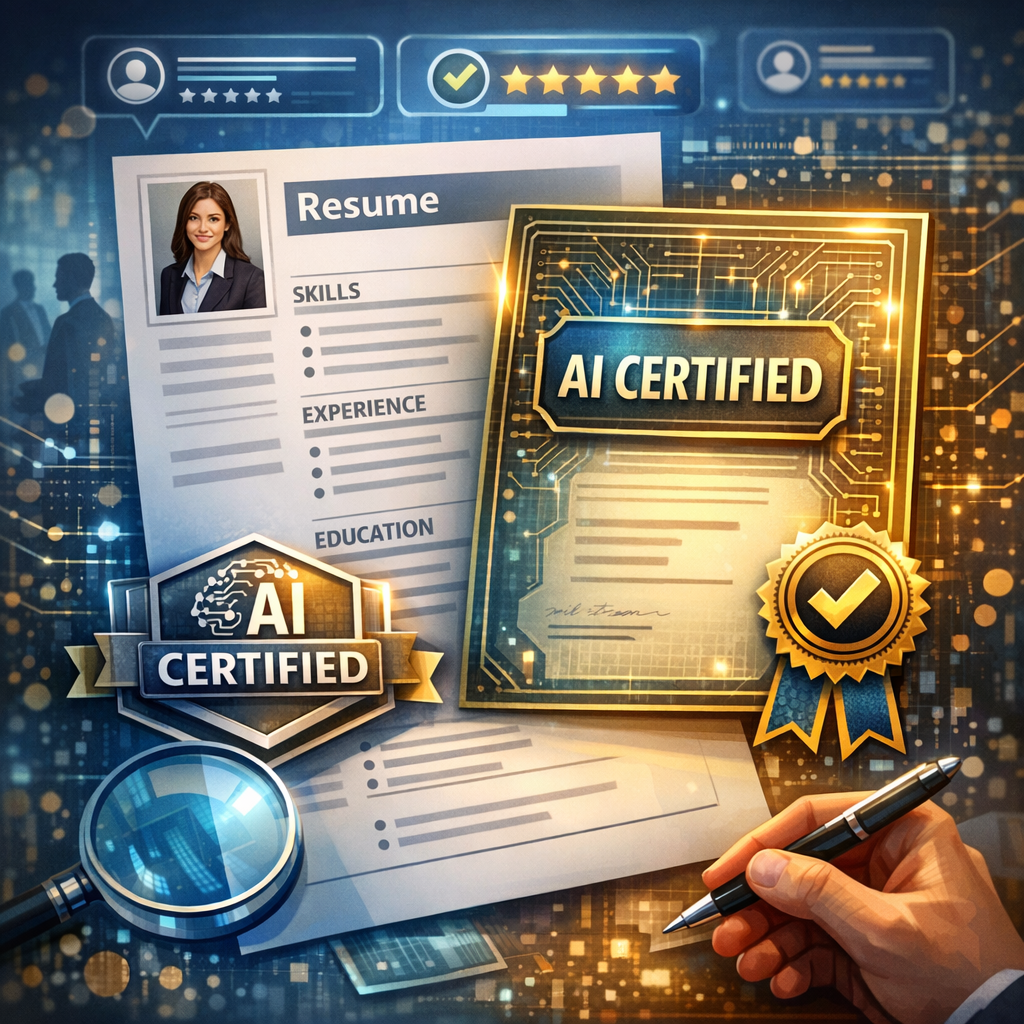
Where you place a certification depends on your experience and how closely it relates to the role. If you are early in your career or changing fields, create a dedicated Certifications section. If the credential supports a specific achievement, mention it within the relevant work or project entry.
Include the certification’s full name, issuing organization, and completion date. If it is directly relevant, add a concise description of the skills it covered.
More importantly, show how you applied what you learned. Instead of listing “AI tools” as a general skill, describe a specific result:
- “Automated weekly report summaries using an AI workflow, reducing manual preparation time.”
- “Built a prototype classification model and evaluated its accuracy against a test dataset.”
- “Used generative AI to draft campaign variations, then reviewed them for brand voice and factual accuracy.”
Use only claims you can explain and support. Be prepared to describe the problem, your process, the tools involved, and the outcome.
Combine Credentials With Evidence
A certification becomes more persuasive when paired with examples. Add a project portfolio, a case study, or a brief description of an AI-related initiative from work or personal study. These examples help employers see how you think, not just what course you completed.
When discussing AI projects, be transparent about your contribution. Explain which parts you handled, how you checked the results, and what decisions required human oversight. This shows practical judgment—an important skill in workplaces where AI outputs may be incomplete or inaccurate.
Keep Your Skills Current
AI tools and best practices change quickly, so a credential should be part of ongoing learning rather than a permanent endpoint. Follow updates in your field, practice with relevant tools, and refresh your portfolio as your skills develop. If a certification requires renewal, keep track of its validity and current requirements.
Ultimately, certified AI credentials boost resume impact most when they reinforce a clear professional story. Choose training that fits your goals, connect it to measurable work, and explain how you use AI thoughtfully. That combination helps employers see not just that you studied AI, but that you can apply it in ways that matter.