
Are AI Certifications Worth It? Industry Standards and Career Benefits
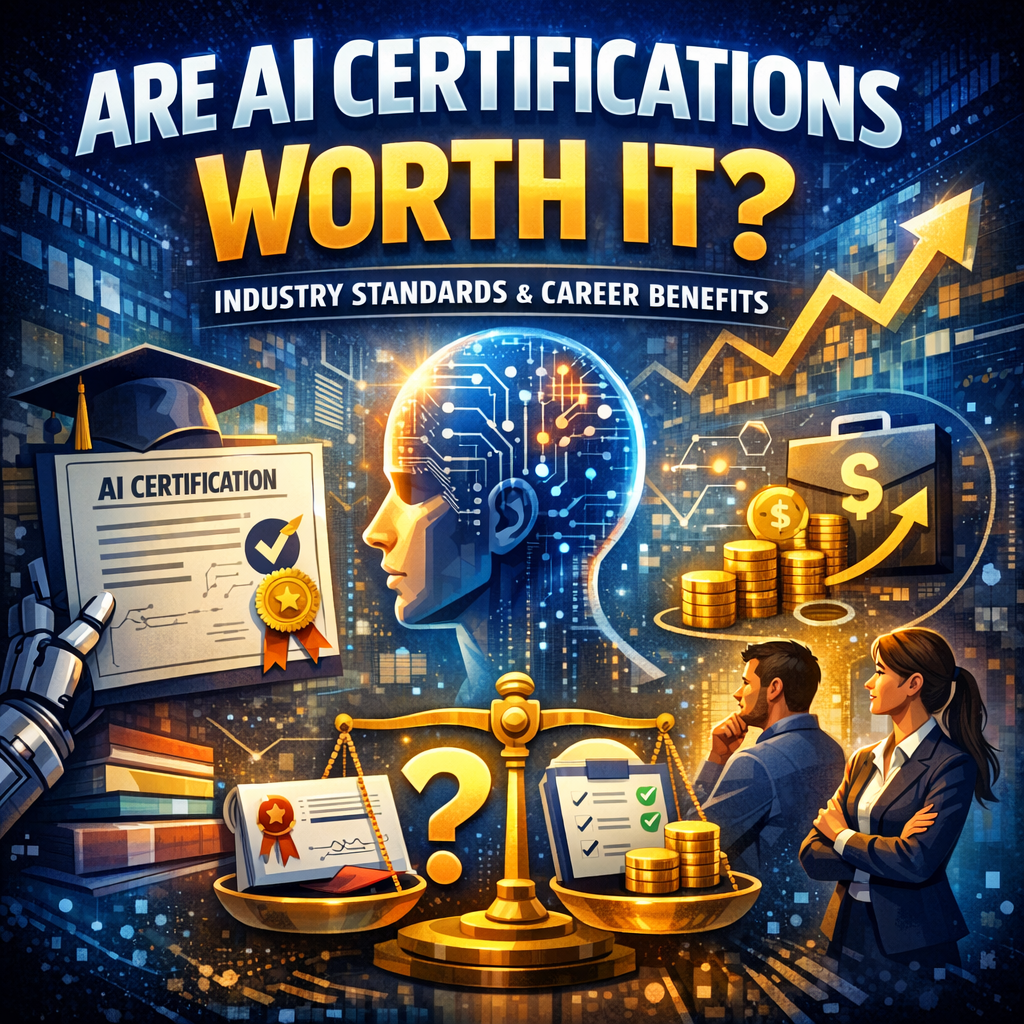
Are AI Certifications Worth It?
Artificial intelligence has moved from a specialized research field into everyday business. As organizations adopt machine learning, generative AI, and automation, professionals are looking for ways to demonstrate relevant skills. That has made AI certifications increasingly popular—but a certificate alone does not guarantee expertise or a job.
Whether AI certifications are worth it depends on your goals, the quality of the program, and how well it complements practical experience. For some learners, a structured credential can provide a useful path into the field. For others, projects, education, or work experience may carry more weight.
What an AI Certification Can Offer
A strong certification program can provide structure in a fast-changing area. Instead of piecing together tutorials, learners follow a curriculum that may cover topics such as machine learning fundamentals, data preparation, model evaluation, responsible AI, and deployment.

Certifications can also help professionals:
- Build foundational knowledge in a defined subject
- Demonstrate initiative when changing roles or industries
- Learn a particular platform or tool set
- Identify gaps in their existing skills
- Add evidence of professional development to a résumé
For people who are new to AI, a guided course can make a broad topic more manageable. For experienced professionals, a focused credential may help validate expertise in a specialized area, such as cloud-based machine learning or AI governance.
How Employers View AI Credentials
Employers generally look at certifications as one signal among many. A recognized credential may help a résumé stand out, particularly when a candidate has limited direct experience. However, hiring teams are likely to ask whether the person can apply what they learned.
For technical roles, that often means being able to explain model choices, work with data, evaluate performance, and discuss limitations. For nontechnical roles, it may mean understanding how AI systems affect workflows, privacy, risk, and decision-making.
A certification is most persuasive when supported by tangible evidence. Examples include a portfolio project, a documented business use case, a contribution to an open-source project, or experience applying AI tools at work. The credential can help open a conversation; practical ability helps sustain it.
Industry Standards and Certification Quality
There is no single universal standard that makes every AI certification equivalent. Programs vary widely in depth, assessment, and recognition. Some are rigorous and require candidates to demonstrate skills, while others mainly confirm course completion.
Before enrolling, investigate the program rather than relying on its marketing. Consider:
Curriculum and assessment
Check whether the course teaches enduring concepts as well as current tools. A useful program should explain fundamentals such as data quality, model evaluation, bias, and security—not just how to follow a series of product-specific steps.
Look for meaningful assessments. Hands-on labs, exams, and projects offer stronger evidence of learning than attendance alone. Review prerequisites too: an advanced certification may assume programming, statistics, or cloud-computing knowledge.
Recognition and relevance
Ask whether the credential is known in your industry and whether it aligns with the work you want to do. A certification from a major technology provider may be relevant for roles using that provider’s platform, but it may not demonstrate broad AI expertise.
For areas involving governance and risk, examine whether the program addresses applicable laws, organizational policies, and responsible AI practices. Standards and regulations continue to evolve, so current course content matters.
Cost and ongoing value
Compare the price with the time required, access to learning materials, exam fees, and renewal requirements. Some credentials need periodic recertification because tools and practices change. That can be worthwhile, but only if the ongoing cost and effort fit your career plans.
When AI Certifications Are Worth It
AI certifications are most valuable when they solve a specific problem. They may be a good investment if you need a structured introduction, want to demonstrate a targeted skill, or are moving into a role where a particular platform or framework is commonly used.
They are less compelling when the program is expensive, vague about its assessment, or disconnected from your goals. A string of certificates without evidence of applied skills may do little to distinguish a candidate.
Before choosing a program, compare it with alternatives such as university courses, professional training, self-directed study, or building a small portfolio. The best route is the one that develops skills you can use and show.
A Practical Way to Decide
Start with the role you want and review several job descriptions. Note the skills, tools, and experience employers repeatedly request. Then identify whether a certification would fill a real gap.
A sensible plan might combine:
- A course or credential for structured learning
- A hands-on project that demonstrates practical ability
- Ongoing study of responsible AI and relevant industry changes
Ultimately, AI certifications can be worth it—but they are not a substitute for competence. Choose a credible program with rigorous assessment, relevant content, and a clear connection to your goals. Treat the certificate as one part of a larger record of learning and applied experience, not as proof that you have mastered AI on its own.