
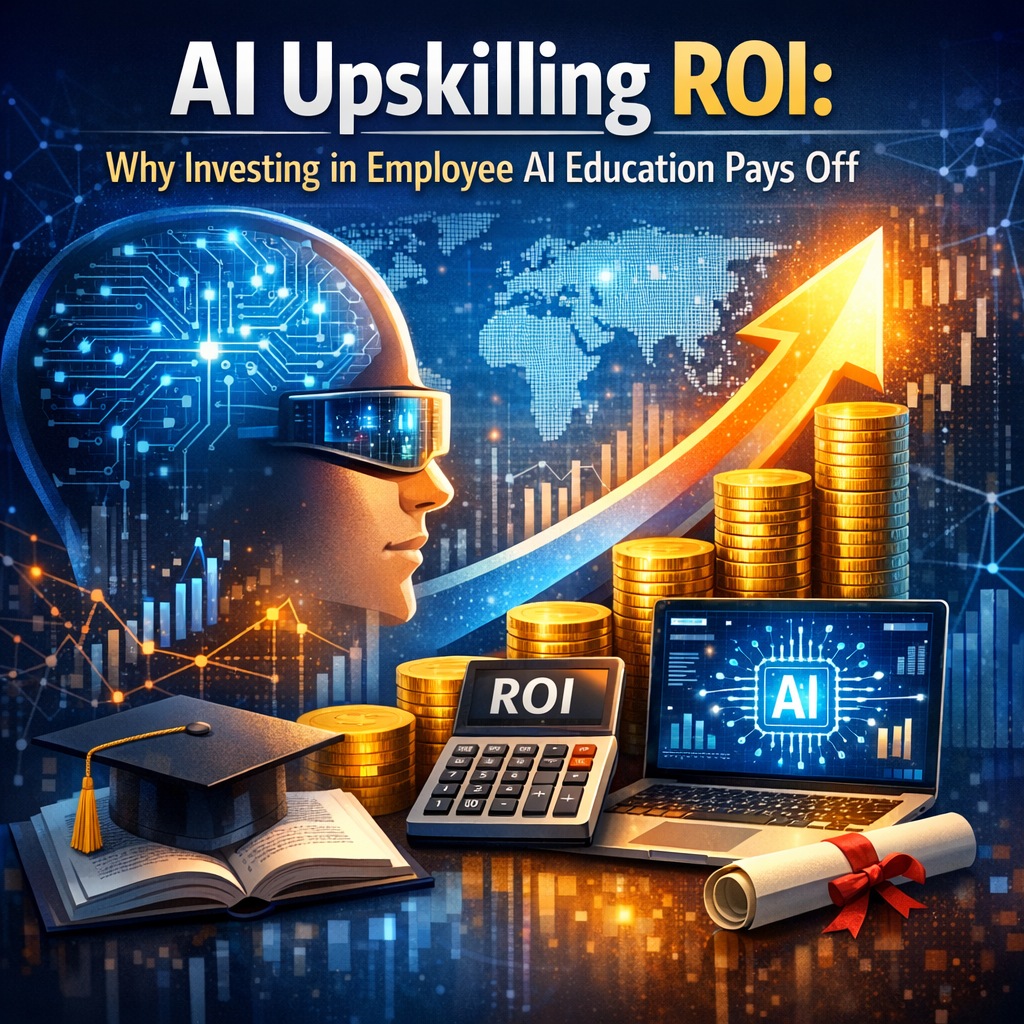
AI Upskilling ROI: Why Investing in Employee AI Education Pays Off
The ROI of AI Upskilling: Why Investing in Employee AI Education Pays Off
Artificial intelligence is changing how work gets done, from drafting and research to data analysis and customer support. Yet adopting new tools is not enough to capture their value. Employees need the skills and judgment to use AI effectively.
That is why the ROI of AI upskilling matters. Teaching people how to work with AI can improve productivity, strengthen decision-making, and help organizations adapt—while reducing the risks of careless or inconsistent use.
How AI Education Creates Business Value
More time for high-value work
AI can help employees summarize information, generate first drafts, organize data, and handle repetitive tasks. With the right training, workers can use these capabilities to spend less time on routine work and more time on activities that require expertise, creativity, and human connection.

The gain is not simply “doing the same work faster.” Teams may also be able to serve more customers, test more ideas, or respond to changing priorities without increasing their workload at the same pace.
Better-quality decisions and outputs
AI tools can produce useful results, but their output is not automatically accurate or appropriate. Employees who understand how to provide context, evaluate responses, and verify important claims are more likely to use AI as a capable assistant rather than an unquestioned authority.
This human oversight can improve the quality of work while helping prevent errors, bias, privacy issues, and inappropriate use of confidential information.
Faster adoption and less wasted spend
Organizations often invest in AI platforms before establishing how employees should use them. Without education, tools may be underused, applied inconsistently, or abandoned after early experimentation.
AI upskilling helps turn technology spending into practical workflows. Employees learn which tasks suit AI, which require human expertise, and how to use approved tools responsibly. That can make existing investments more productive.
Calculating the ROI of AI Upskilling
The return on an AI training program is not always captured by a single metric. A useful assessment combines productivity measures with indicators of quality, adoption, and risk.
Before training begins, establish a baseline. Then compare results over time, using measures such as:
- Time required to complete selected tasks
- Output quality, revision rates, or error frequency
- Employee adoption of approved AI tools
- Customer response times or satisfaction
- Costs associated with manual processes
- Incidents involving data handling or inaccurate AI output
For example, a team might track how long it takes to prepare a recurring report before and after training. If the process becomes faster without increasing corrections or reducing quality, the organization can estimate the value of the time saved.
It is also important to account for the cost of training, including employee time, course materials, and ongoing support. The goal is not to claim that every saved minute translates directly into cash. Instead, organizations should identify how recovered capacity is being used and whether it contributes to measurable business outcomes.
What Effective AI Upskilling Looks Like
Focus on real work
Generic demonstrations can build familiarity, but employees learn more when training relates to their daily responsibilities. Marketing teams may practice research and content workflows, while analysts may focus on data interpretation and summarization.
Training should help employees decide when AI is useful, how to give clear instructions, and how to check the result before acting on it.
Teach responsible use
Strong AI education covers more than prompts. Employees need guidance on privacy, security, intellectual property, bias, and fact-checking. Clear rules help people understand which tools are approved and what information should never be entered into them.
This guidance protects the organization and gives employees confidence to experiment within appropriate boundaries.
Make learning ongoing
AI tools and best practices evolve quickly. A one-time workshop may introduce the basics, but ongoing learning helps employees adapt as tools change and new use cases emerge. Short refreshers, peer sharing, and practical examples can keep knowledge relevant without overwhelming teams.
A Strategic Investment in People
The ROI of AI upskilling comes from combining technology with human capability. Tools may generate options, but employees bring context, judgment, accountability, and knowledge of the organization’s goals.
Companies that invest in employee AI education are better positioned to turn experimentation into dependable results. By measuring outcomes, teaching responsible practices, and connecting training to real tasks, organizations can make AI adoption more productive—and help their workforce thrive as the nature of work continues to change.