
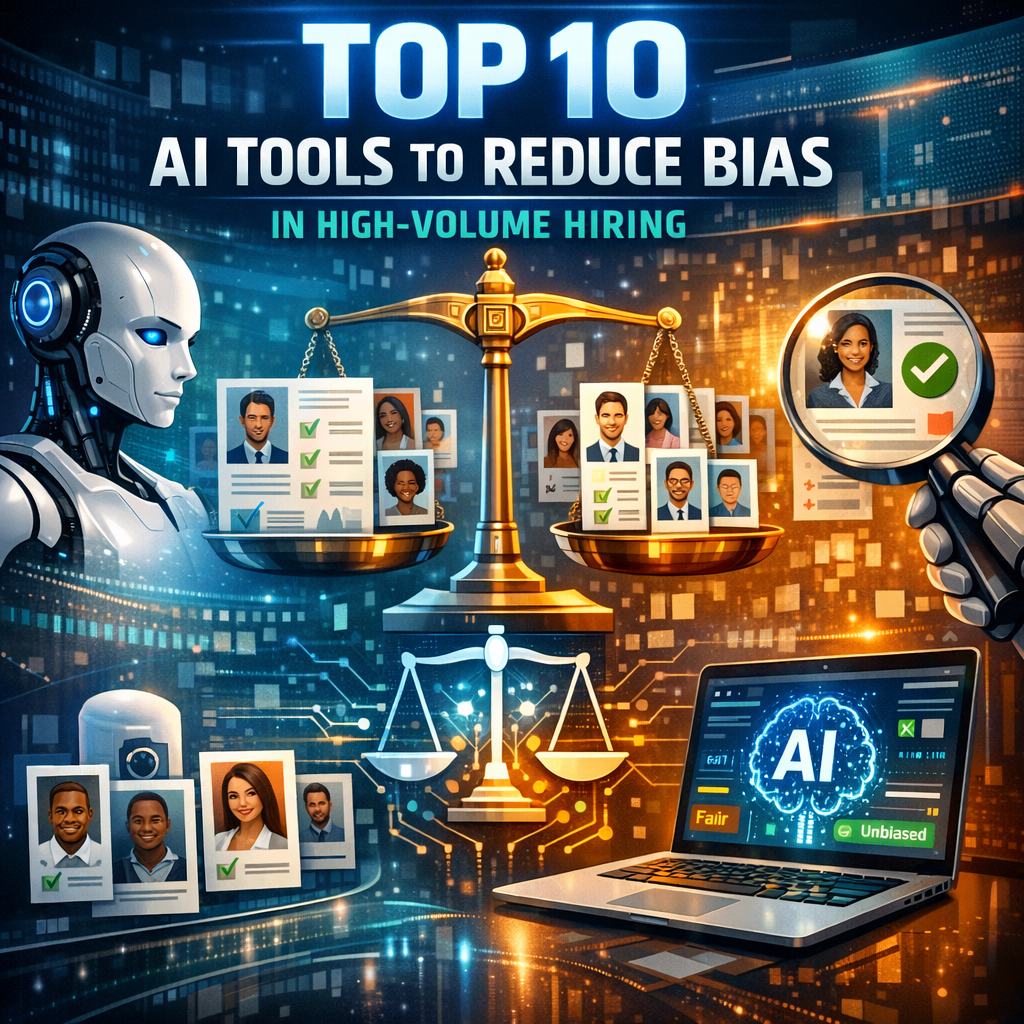
Top 10 AI Tools to Reduce Bias in High-Volume Hiring
Top 10 AI Tools Eliminating Bias in High-Volume Hiring
High-volume hiring can magnify small inconsistencies. When hundreds or thousands of applicants move through the same process, automated tools may help teams apply clearer criteria, widen candidate pools, and reduce repetitive screening work.
But no AI system can eliminate bias on its own. Results depend on the data, settings, assessments, and human decisions behind it. These ten tools offer features that can support fairer hiring when paired with regular audits and thoughtful oversight.
1. Applied
Applied focuses on structured, skills-based hiring. Employers can use work-sample questions and consistent scoring rubrics, while anonymized applications can help reviewers focus on candidates’ responses rather than identifying details. Its approach is especially useful when employers want to assess job-relevant skills early.

2. Textio
Textio analyzes job descriptions and other hiring content for language that may discourage some candidates from applying. Its writing guidance helps teams make job ads clearer and more inclusive. This can broaden the applicant pool, although inclusive wording alone cannot ensure fair screening later in the process.
3. HireVue
HireVue offers tools for structured interviews and assessments at scale. Employers can give candidates consistent questions and use defined evaluation criteria, reducing reliance on informal interviews that vary from person to person. Organizations should verify that assessments are relevant to the role and monitor outcomes across candidate groups.
4. Harver
Harver provides volume-hiring assessments and workflow tools, including capabilities associated with its Pymetrics acquisition. Employers can use job-related assessments to evaluate candidates consistently before interviews. Assessment design matters: organizations should validate each test for the role and check that it does not create unnecessary barriers.
5. Eightfold AI
Eightfold AI uses talent intelligence and skills-based matching to help recruiters identify candidates whose experience may fit a role, including people with nontraditional career paths. This can reduce overreliance on familiar job titles or employers. Recruiters should still review recommendations and test whether matching patterns disadvantage particular groups.
6. HiredScore AI for Recruiting
Now part of Workday, HiredScore helps recruiters prioritize candidates and coordinate recruiting workflows. Its recommendations can surface applicants who might otherwise be overlooked in a large queue. Teams should understand how the system ranks or flags candidates and ensure its signals do not replace job-related judgment.
7. SeekOut
SeekOut supports talent sourcing and candidate discovery across large talent pools. Its search tools can help recruiters look beyond the same networks and frequently used sources, broadening outreach. Sourcing diversity is only one part of fair hiring, so employers should also review how candidates are screened and assessed afterward.
8. Paradox
Paradox automates recruiting conversations, including scheduling and early-stage candidate interactions. Consistent prompts and workflows can make the process more predictable for applicants and reduce the effect of ad hoc screening. Employers should make sure automated questions are accessible, necessary, and directly connected to the job.
9. Sapia.ai
Sapia.ai uses conversational AI to support candidate screening through structured text-based interviews. A consistent format can help teams compare responses against defined criteria rather than relying solely on résumé signals or unstructured conversations. Organizations should evaluate the questions, scoring methods, and results for relevance and fairness.
10. Greenhouse
Greenhouse is an applicant tracking and hiring platform with tools for structured interviews, interview kits, and scorecards. These features help hiring teams agree on criteria before meeting candidates and record feedback consistently. While structure does not guarantee unbiased decisions, it makes inconsistencies easier to identify and address.
How to Choose a Fairer Hiring Tool
Before adopting any AI hiring tool, ask vendors and internal teams:
- What data and criteria influence recommendations or scores?
- Has the system been tested for accuracy and disparate outcomes?
- Can recruiters explain and challenge its recommendations?
- Are assessments accessible and relevant to the actual work?
- How will the organization monitor results over time?
The strongest approach combines technology with clear hiring standards. Define job-related criteria before screening begins, train recruiters on consistent evaluation, and regularly review who advances and who is screened out. AI tools can make high-volume hiring more consistent, but accountability remains with the organization using them.