

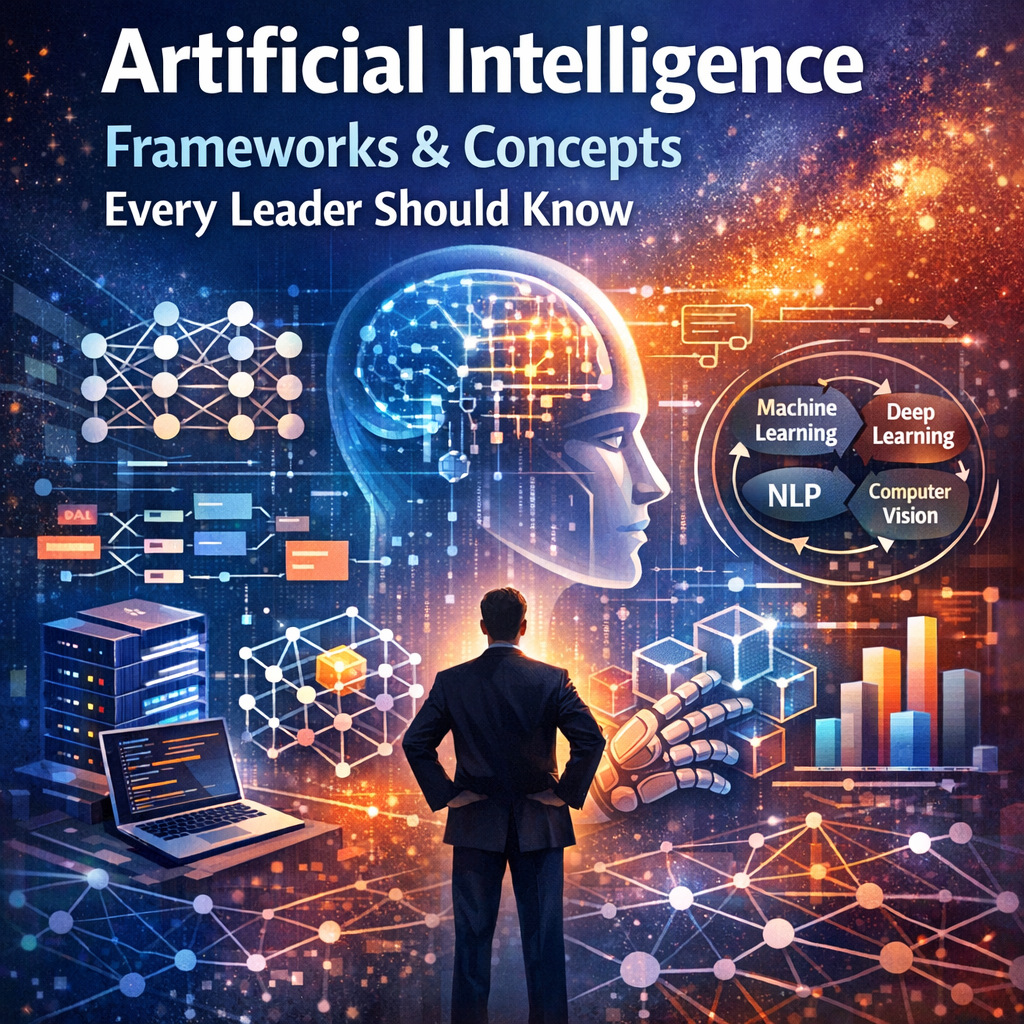
Artificial Intelligence Frameworks and Concepts Every Leader Should Know
Top Artificial Intelligence Frameworks and Concepts Every Leader Must Understand
Artificial intelligence is no longer confined to research labs. It is influencing customer service, product development, forecasting, and everyday business operations. Leaders do not need to build models themselves, but they do need to understand the artificial intelligence frameworks and concepts behind the tools they evaluate.
That knowledge helps organizations identify realistic opportunities, ask better questions, and manage risks before they become costly problems.
Start With the Core AI Concepts
Machine learning
Machine learning (ML) enables software to identify patterns in data and use them to make predictions or recommendations. A model might estimate customer churn, detect unusual transactions, or forecast demand.

ML is useful when an organization has relevant, reliable data and a clear outcome to predict. It is not a magic shortcut: poor-quality data can produce unreliable results.
Deep learning
Deep learning is a branch of machine learning that uses neural networks with many layers. It powers capabilities such as image recognition, speech processing, and advanced language generation.
These models can be highly capable, but they often require more computing power and data than simpler approaches. Leaders should consider whether the added complexity is justified by the business need.
Generative AI and foundation models
Generative AI creates new content, including text, images, audio, and code. Many generative tools are built on foundation models: large models trained on broad datasets that can be adapted to a range of tasks.
Foundation models can accelerate experimentation, but their outputs may be inaccurate, outdated, or inappropriate. Human review remains important, especially for decisions affecting customers, employees, or compliance.
Understand the Frameworks Behind AI Solutions
In technology, an AI framework is software that helps teams build, train, or deploy models. These tools differ in their strengths and are not interchangeable.
- PyTorch is widely used for deep learning research and development, offering flexibility for teams experimenting with neural networks.
- TensorFlow supports building and deploying machine-learning models across different environments, including mobile and cloud applications.
- scikit-learn provides accessible tools for common machine-learning tasks, such as classification, regression, and clustering.
- Hugging Face Transformers makes it easier to work with pretrained language, vision, and audio models.
- LangChain helps developers connect language models with data sources and other tools when building applications.
Leaders do not need to choose a framework based on popularity alone. The right choice depends on the team’s skills, existing technology, security requirements, deployment plans, and the problem being solved.
Know How AI Connects to Business Data
Retrieval-augmented generation
Retrieval-augmented generation, or RAG, connects a generative AI model to selected information sources. When a user asks a question, the system retrieves relevant material and uses it to produce a response grounded in that content.
RAG can help organizations build assistants that answer questions using internal policies, product documentation, or approved reference materials. It can improve relevance, but it does not guarantee correctness. Source quality, access controls, and testing still matter.
AI agents and automation
AI agents are systems that can pursue a goal by taking steps, using tools, or interacting with other software. For example, an agent might gather information, draft a report, and route it for approval.
The promise is greater automation; the risk is that a system may take an incorrect action or operate beyond its intended scope. Start with limited permissions, clear approval points, and thorough monitoring.
Make Governance Part of the Design
Responsible AI is not a final checklist added after deployment. It is an ongoing practice that addresses privacy, security, fairness, transparency, and accountability.
Before approving an AI use case, leaders should ask:
- What business problem does it solve, and how will success be measured?
- What data will it use, and is that data appropriate and protected?
- Who reviews its outputs and takes responsibility for decisions?
- How will errors, bias, and performance changes be detected?
- Can the organization explain the system’s role to affected people?
Choose Use Cases With Care
A promising AI initiative connects a defined need with suitable data, accountable owners, and measurable results. Begin with a contained pilot, compare performance with the current process, and include the people who will use or be affected by the system.
Understanding the leading artificial intelligence frameworks and concepts helps leaders move beyond hype. With clear goals, sound governance, and ongoing evaluation, organizations can adopt AI in ways that create value while keeping people and responsibility at the center.