
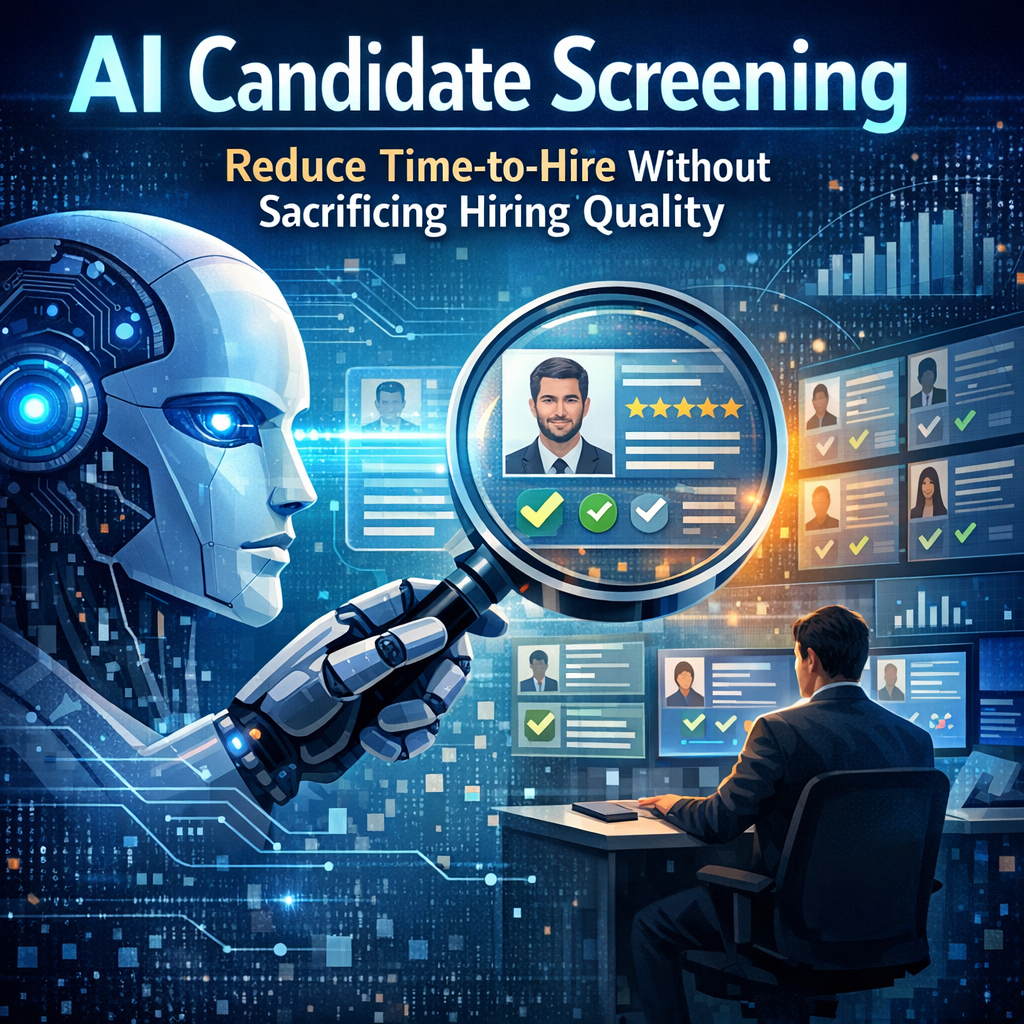
AI Candidate Screening: Reduce Time-to-Hire Without Sacrificing Hiring Quality
AI Candidate Screening: How to Reduce Time-to-Hire Without Sacrificing Quality
Hiring teams often face a difficult balance: fill roles quickly while still finding candidates who can succeed. AI candidate screening can help reduce repetitive work, but speed alone is not a useful measure of hiring success. The goal is to make the process more efficient without letting automated tools make poorly understood or unfair decisions.
Used thoughtfully, AI can help recruiters focus their attention where human judgment matters most.
What AI Candidate Screening Can Do
AI candidate screening refers to software that supports early-stage recruiting tasks. Depending on the tool, it may help organize applications, identify job-related skills in resumes, answer candidate questions, or summarize interview notes.

These systems can make large application volumes easier to manage. For example, they may help recruiters find applicants who mention relevant certifications or experience, reducing the time spent searching documents manually.
AI should be treated as decision support—not as a substitute for a qualified hiring team. It can surface information, but people should remain responsible for interpreting it and making consequential decisions.
Start With a Clear Definition of “Qualified”
Automation cannot improve hiring criteria that are vague, outdated, or unrelated to the job. Before introducing a screening tool, hiring managers and recruiters should agree on what the role genuinely requires.
Separate the criteria into categories such as:
- Essential qualifications: Requirements that are necessary to perform the job.
- Trainable skills: Capabilities a successful hire can learn after joining.
- Evidence of potential: Examples of problem-solving, communication, or relevant accomplishment.
- Nonessential preferences: Details that should not determine who advances.
This step helps prevent a system from rewarding superficial similarities to previous employees or favoring applicants with particular career paths. It also makes screening decisions easier to explain and review.
Use AI to Reduce Administrative Delays
The most useful early applications of AI often involve removing bottlenecks rather than automatically rejecting candidates. A tool might help sort applications for recruiter review, summarize relevant experience, schedule interviews, or provide prompt answers to routine questions.
These improvements can reduce time-to-hire in several ways:
- Faster application review: Recruiters can spend less time locating basic information.
- Quicker communication: Automated updates can help candidates understand what happens next.
- More consistent workflows: Standardized steps reduce avoidable delays between screening and interviews.
- Better recruiter focus: Hiring teams can devote more time to conversations and assessment.
Keep the process transparent. Candidates should know when automation plays a meaningful role, and there should be a clear route to request assistance or raise a concern.
Protect Quality With Human Review
A résumé does not tell the whole story. Candidates may describe the same experience in different language, come from nontraditional backgrounds, or have gaps that automated systems interpret poorly. Human review is especially important when a tool ranks, filters, or recommends applicants.
Set practical safeguards:
- Require a recruiter to review the evidence behind a recommendation.
- Avoid automatic rejection based on a single keyword or score.
- Give candidates a reasonable way to correct inaccurate information.
- Train hiring teams to use tool outputs critically, not as definitive judgments.
- Keep records of how screening decisions are made.
Structured interviews and job-related assessments can also help validate whether a candidate has the skills needed for the role. Apply the same relevant criteria to each candidate, and make reasonable accommodations available.
Check for Bias and Compliance
AI systems can reflect patterns in the data used to build or configure them. If past hiring decisions favored certain groups, a tool trained on those decisions may repeat that pattern. Vendors’ claims should therefore be evaluated, not accepted at face value.
Before deployment, ask how the system works, what data it uses, how often it is tested, and whether its results can be audited. Review outcomes for potential disparities across groups where legally permitted, and consult legal or compliance experts about applicable requirements. Continue monitoring after launch; a tool that performs well in one role or location may not be appropriate for another.
Measure More Than Hiring Speed
Track whether AI candidate screening actually improves the hiring process. Useful measures include:
- Time from application to first response
- Time-to-hire by role and hiring stage
- Candidate withdrawal rates
- Recruiter hours spent on administrative tasks
- Interview-to-offer and offer-acceptance rates
- Quality-of-hire indicators, such as retention and performance
- Screening outcomes across candidate groups
Compare results with a baseline and investigate unexpected changes. A shorter hiring cycle is not a success if qualified applicants are being missed or new hires are less likely to thrive.
Make Efficiency Serve Better Hiring
AI candidate screening works best when it supports a carefully designed process. Define job-related criteria, automate repetitive tasks, preserve human oversight, and check outcomes regularly. The result can be a faster experience for recruiters and candidates alike—without confusing speed with quality.