
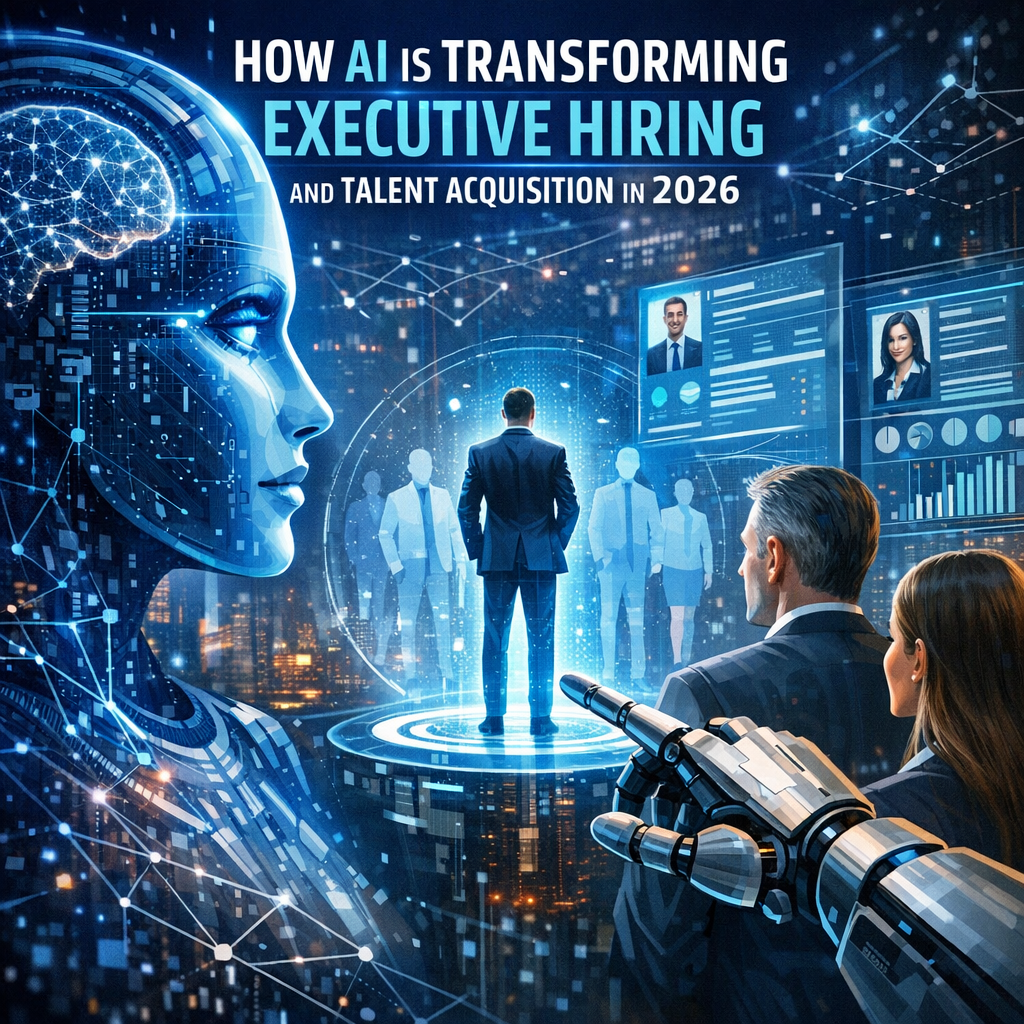
How AI Is Transforming Executive Hiring and Talent Acquisition in 2026
How AI Is Transforming Executive Hiring and Talent Acquisition in 2026
Executive hiring has always depended on judgment, relationships, and a careful reading of leadership potential. In 2026, artificial intelligence is adding new ways to find candidates, assess experience, and coordinate complex searches. The result is not a fully automated hiring process. Instead, AI in executive hiring is helping talent teams work faster and make better-informed decisions—when it is used with care.
From Broad Searches to More Precise Candidate Discovery
Traditional executive searches often begin with networks, referrals, and manual research. AI tools can now analyze public professional profiles, career histories, skills, and company information to identify potential candidates who might otherwise be overlooked.
Recruiters can use these tools to:

- Map talent across industries and regions
- Find leaders with specific combinations of experience
- Identify adjacent backgrounds that may fit a role
- Organize and prioritize large candidate pools
This can broaden a search beyond familiar networks. For instance, a company seeking a chief technology officer might consider leaders from a related sector if their experience in scaling teams or managing transformation is relevant.
AI-generated matches are starting points, not recommendations to accept unquestioningly. Search criteria can reflect outdated assumptions, and incomplete data may hide promising candidates. Recruiters still need to review profiles and understand the context behind each career move.
Faster Processes, More Time for Relationships
Executive recruitment involves detailed work: reviewing resumes, preparing briefing materials, scheduling interviews, and keeping stakeholders aligned. AI assistants can help summarize candidate information, draft communications, compare notes, and handle routine coordination.
These efficiencies matter because senior candidates expect a thoughtful process. When recruiters spend less time on administrative tasks, they can devote more attention to confidential conversations, candidate concerns, and the nuances of leadership fit.
AI can also improve communication across a search team. Shared summaries and structured interview notes help reduce information gaps between recruiters, hiring managers, and board members. However, generated content should be checked for accuracy and tone before it is shared, especially when it includes sensitive or personal information.
Assessing Leadership Beyond the Resume
A resume offers only part of the picture. Executive hiring also requires evaluating strategic thinking, communication, decision-making, adaptability, and the ability to lead through uncertainty.
AI can help structure that evaluation by organizing interview feedback around consistent criteria or summarizing themes from several interview rounds. Some platforms also support skills-based assessments and scenario exercises. Used appropriately, these methods can make comparisons clearer and reduce reliance on unstructured impressions.
Still, leadership potential cannot be reliably reduced to a score. AI systems may produce confident-looking results without capturing context, such as the challenges a candidate faced or the resources available in a previous role. Human interviewers need to test conclusions, ask follow-up questions, and distinguish evidence from inference.
The Risks of Bias, Privacy, and Overreliance
The use of AI in executive hiring brings real responsibilities. Models trained on historical hiring data can reproduce patterns that disadvantaged certain groups. Tools that analyze language, career paths, or online activity may also make judgments that are difficult to explain or challenge.
To manage these risks, employers should:
- Review tools for bias and validate them against job-related criteria
- Tell candidates when AI is used in meaningful parts of the process
- Protect personal data and limit access to those who need it
- Provide a way for people to question or correct inaccurate information
- Keep humans accountable for consequential hiring decisions
Privacy deserves particular attention in senior searches, where a candidate’s interest in a new role may be confidential. Organizations should avoid collecting unnecessary data and confirm that vendors handle candidate information responsibly.
A Human-Led Future for Executive Talent Acquisition
The strongest approach in 2026 pairs AI’s speed and analytical capacity with human judgment. Technology can help surface candidates, organize evidence, and highlight questions worth exploring. It cannot fully understand trust, organizational culture, board dynamics, or the personal motivations behind a leadership decision.
For companies, the goal is not to automate executive hiring from end to end. It is to make the process more focused, fair, and responsive while preserving meaningful human contact. For recruiters, AI is most valuable as a capable assistant—not as the final decision-maker.
As these tools continue to develop, organizations that invest in transparent practices and thoughtful oversight will be better positioned to use AI in executive hiring responsibly. The most successful searches will still depend on people: leaders who can recognize potential, build trust, and choose the right person for the work ahead.