
Autonomous Workforce: How AI Agents and Human Talent Will Coexist
Autonomous Workforce: How AI Agents and Human Talent Will Coexist
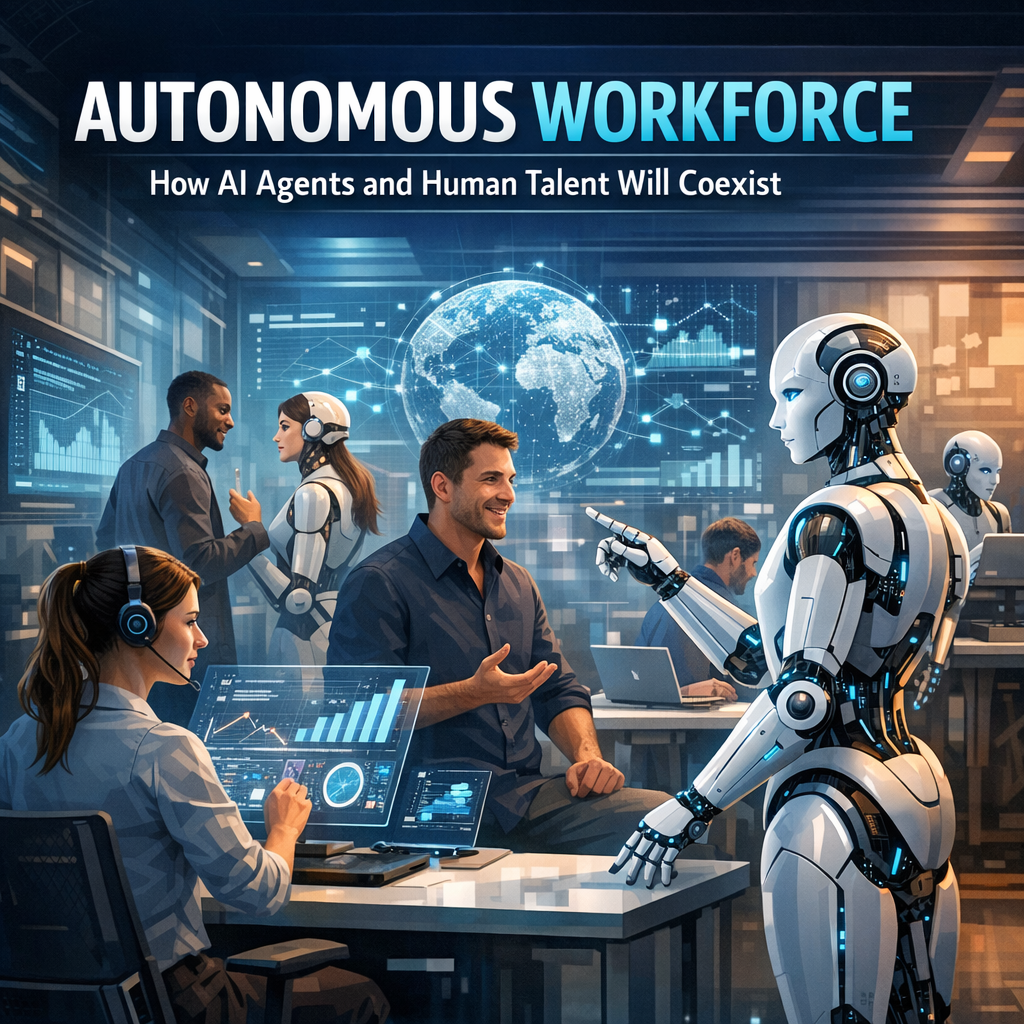
The workplace is changing as artificial intelligence moves beyond answering questions and begins handling tasks. AI agents can research, analyze information, draft content, manage workflows, and coordinate with software tools. As these systems become more capable, organizations are building an autonomous workforce in which people and AI agents contribute to shared goals.
“Autonomous” does not mean fully independent or free from oversight. In most workplaces, agents will operate within defined boundaries, while people set priorities, make important judgments, and take responsibility for outcomes. The challenge is not choosing between human talent and AI. It is designing work so each can do what it does best.
What an AI Agent Brings to Work
Unlike a conventional tool that responds to a single instruction, an AI agent can pursue a goal through multiple steps. Depending on its permissions and design, it may break a task into smaller actions, use approved tools, and report back when the work is complete—or when it needs human input.

That makes agents especially useful for structured, repeatable activities, such as:
- Sorting and summarizing incoming requests
- Gathering information for reports
- Updating records across business systems
- Drafting routine communications
- Monitoring workflows for delays or exceptions
Agents can help work move faster, but speed alone is not the measure of success. Their outputs still need to be accurate, relevant, secure, and aligned with organizational standards.
The Human Skills That Matter More
People bring qualities that current AI systems do not reliably reproduce: lived experience, empathy, ethical judgment, and an understanding of social and organizational context. A human employee may recognize that a technically correct response could upset a customer, create unfairness, or overlook an important exception.
Human talent is also essential for defining the goals an agent should pursue. Someone must decide what “good” looks like, which trade-offs are acceptable, and when a task is too sensitive to automate. These responsibilities become more important—not less—as agents gain the ability to act across multiple systems.
In an autonomous workforce, people are likely to spend less time on repetitive coordination and more time on work that involves:
- Building relationships with customers and colleagues
- Making decisions under uncertainty
- Setting strategy and priorities
- Reviewing high-impact or unusual cases
- Improving processes and developing new ideas
Designing Effective Human–AI Collaboration
Successful collaboration begins with clear boundaries. An agent should have access only to the information and tools needed for its role. Its instructions should identify when it can act independently, when it must seek approval, and when it should stop and escalate a task.
Organizations should also keep people accountable for consequential decisions. For example, an agent might prepare a hiring shortlist, but a qualified human should evaluate candidates and make the final decision. An agent might draft a response to a customer complaint, while an employee checks the tone and context before sending it.
A practical approach is to introduce agents in stages:
- Start with well-defined tasks. Choose work that is repetitive, measurable, and relatively low risk.
- Keep a human in the loop. Review outputs and require approval before agents take consequential actions.
- Measure quality, not just speed. Track errors, rework, customer experience, and employee workload.
- Expand carefully. Increase autonomy only when performance and safeguards are reliable.
- Update the process. Treat implementation as a continuing effort, not a one-time software installation.
Addressing Risks and Workforce Concerns
Greater automation raises legitimate questions about job security, privacy, bias, and accountability. Employees may worry that agents will replace their roles or increase monitoring. Employers should address these concerns openly, explain how AI will be used, and involve workers in decisions that change their day-to-day responsibilities.
Training is central to that effort. Employees need practical guidance on how to supervise agents, verify results, protect sensitive information, and recognize when an AI-generated answer may be unreliable. Organizations may also need to redesign roles as routine tasks shift, creating opportunities for people to build skills in analysis, communication, and oversight.
Clear governance matters, too. Teams should document where agents are used, test them for errors and bias, and establish a way to report problems. When an agent makes a mistake, responsibility should not disappear into the technology. People and organizations must remain answerable for how these systems are selected, configured, and used.
Building a Workforce That Works Together
The autonomous workforce is not a future made up of machines working alone. It is a model in which AI agents take on bounded tasks and people provide direction, judgment, creativity, and care. The best results will come when organizations treat AI as a capable collaborator—not a substitute for human responsibility.
That balance requires thoughtful design and continual learning. With clear limits, meaningful oversight, and investment in employee skills, AI agents can reduce routine burdens while giving people more room to focus on work that depends on human insight.