
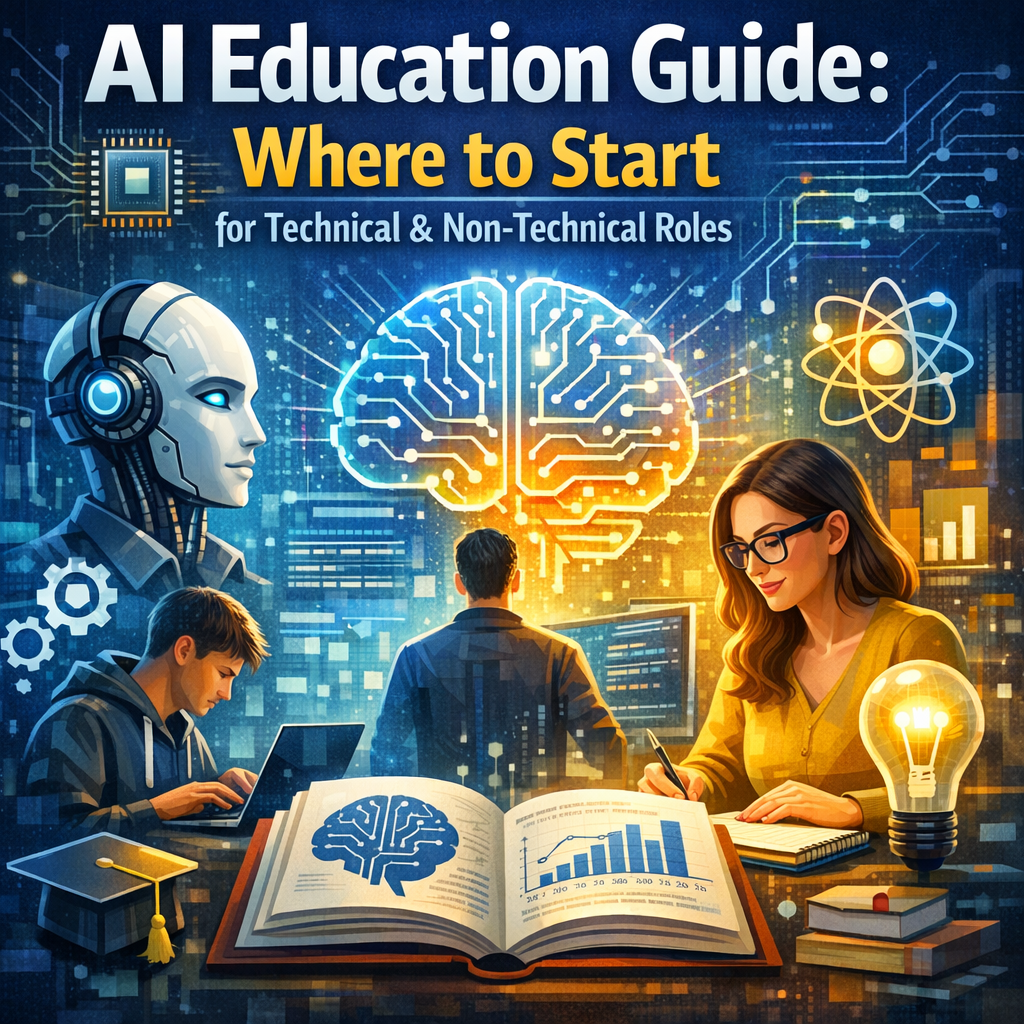
AI Education Guide: Where to Start for Technical and Non-Technical Roles
Demystifying AI Education: Where to Begin for Technical and Non-Technical Roles
Artificial intelligence is changing how organizations build products, serve customers, and make decisions. Yet starting an AI education can feel daunting. The field includes everything from basic automation to advanced machine learning, and not every role requires the same skills.
The best place to begin is with your goals. Whether you work in engineering, marketing, operations, or management, you can build practical AI knowledge without trying to learn everything at once.
Start With AI Fundamentals
Before choosing a specialized course, learn the basic ideas behind AI. Understand what artificial intelligence, machine learning, generative AI, and large language models mean—and how they differ.

You do not need complex mathematics to grasp the essentials. Focus on what these systems can do, how they learn from data, and where they tend to make mistakes. It is also helpful to learn about common limitations, including inaccurate outputs, bias, privacy risks, and overconfidence.
A strong foundation helps you evaluate AI tools realistically instead of treating them as either magic or a threat.
AI Education for Non-Technical Roles
Non-technical professionals can benefit from AI education without learning to code. The priority is understanding how to use AI tools effectively and responsibly within everyday work.
Start with practical tasks such as drafting, summarizing, brainstorming, organizing information, or analyzing feedback. Try a tool on low-risk work, then review its output carefully. The goal is not to delegate judgment, but to make routine tasks more efficient.
Useful skills for non-technical roles include:
- Prompting: Giving clear instructions, context, and examples to get more useful results.
- Output evaluation: Checking claims, tone, sources, and completeness before using AI-generated work.
- Workflow awareness: Identifying repetitive tasks that might benefit from AI assistance.
- Responsible use: Protecting confidential information and following workplace policies.
- Communication: Explaining AI’s strengths and limitations to colleagues and customers.
People in roles such as human resources, sales, education, and project management may also want to explore AI use cases specific to their industries. A general introduction is valuable, but role-based practice makes the learning easier to apply.
AI Education for Technical Roles
Technical professionals may need a deeper understanding of how AI systems are built, tested, and integrated. The right starting point depends on your current experience.
If you are new to programming, begin with a language commonly used in AI development, such as Python. Learn basic programming concepts, then practice working with data: loading it, cleaning it, exploring it, and visualizing patterns.
From there, explore foundational topics such as:
- Statistics and probability
- Supervised and unsupervised learning
- Model training and evaluation
- Neural networks and deep learning
- APIs, deployment, and monitoring
You do not need to master every topic before building something. A small project—such as a simple text classifier or prediction tool—can connect abstract concepts to real decisions. Experienced developers may instead focus on integrating AI services, evaluating model performance, or building reliable applications around generative AI.
Choose a Learning Path That Fits Your Goals
AI education works best when it combines structured learning with hands-on practice. A short course, book, or guided tutorial can provide a roadmap, while a personal or work-related project helps reinforce the material.
When choosing learning resources, consider:
- Your current experience level
- Whether you need broad literacy or technical depth
- The time you can realistically commit
- Opportunities to practice with real examples
- Whether the material covers ethics, privacy, and evaluation
Be cautious of programs that promise instant expertise. AI tools and techniques change quickly, so the ability to keep learning is more valuable than memorizing a particular platform’s features.
Make Responsible Use Part of the Learning
AI skills involve more than getting a tool to produce an answer. Users must decide whether that answer is appropriate, accurate, and safe to use.
Build habits such as checking important facts against reliable sources, removing sensitive data from prompts, and disclosing AI assistance when required. In technical work, consider how a model performs across different groups and situations. In non-technical work, ask who could be affected by an automated recommendation or decision.
These practices make AI use more trustworthy and help teams avoid preventable mistakes.
Begin Small and Keep Building
You do not need to choose between a technical career path and a non-technical one before starting. Begin with AI fundamentals, apply them to tasks you already understand, and deepen your skills as your goals become clearer.
A thoughtful AI education is not about chasing every new tool. It is about learning what AI can do, where human judgment remains essential, and how to use the technology with purpose.