
AI vs. Traditional Recruitment: How Smart Automation Outperforms Legacy Hiring
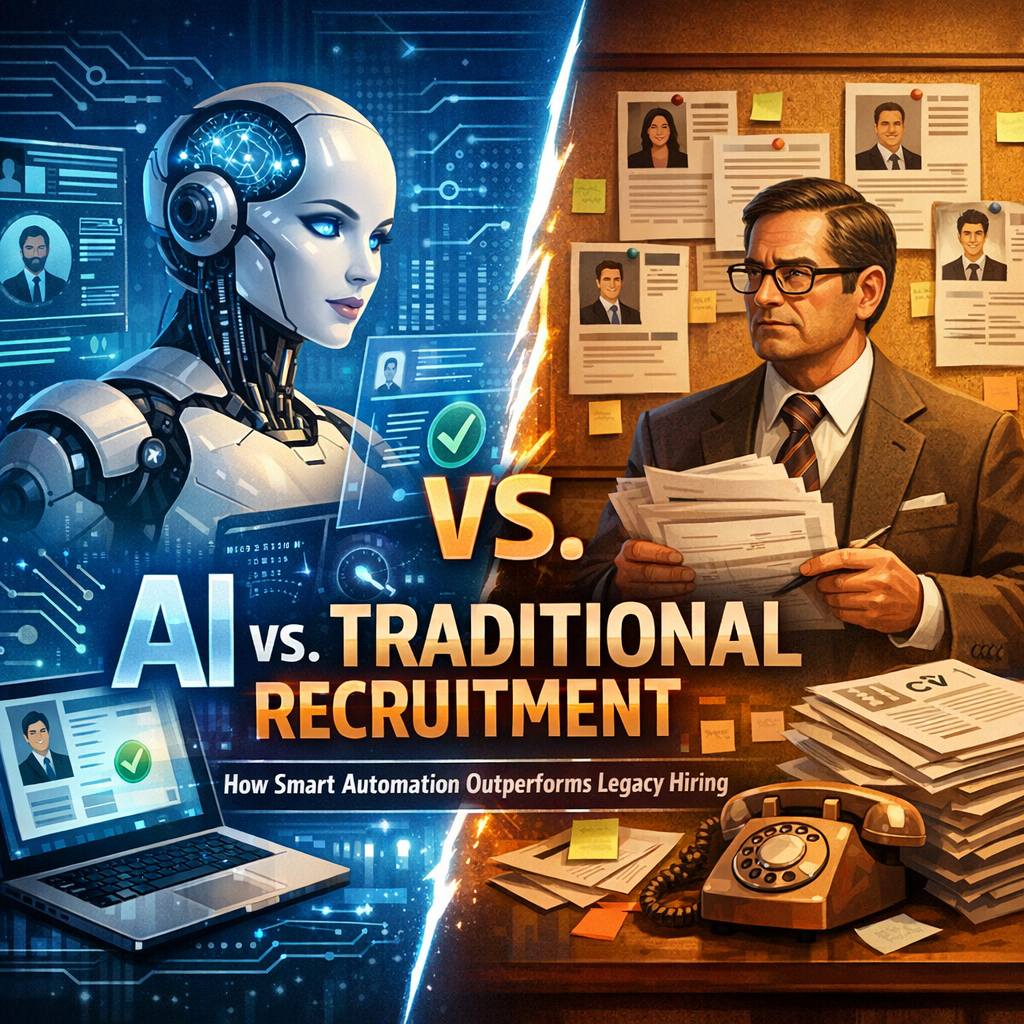
AI vs. Traditional Recruitment: How Smart Automation Outperforms Legacy Methods
Recruiting has always involved a balancing act: finding qualified people quickly while giving every candidate a fair, thoughtful experience. Traditional recruitment methods often rely on manual résumé reviews, spreadsheets, email chains, and repeated scheduling tasks. These approaches can work, but they become difficult to manage as application volumes grow.
The comparison of AI vs. traditional recruitment is not simply about replacing people with technology. It is about using smart automation to reduce repetitive work, surface useful insights, and help recruiters focus on decisions that benefit from human judgment.
Where Traditional Recruitment Falls Short
Legacy hiring processes can be slow and inconsistent. Recruiters may spend hours reading applications, copying information between systems, and coordinating interviews. When one role attracts hundreds of candidates, it is easy for strong applicants to wait too long for a response—or to be overlooked altogether.

Manual processes also make it harder to apply consistent screening criteria. Different reviewers may interpret job requirements differently, especially when hiring teams are under pressure. Spreadsheets and disconnected tools can add further friction, making it difficult to track progress or understand where candidates are dropping out.
These challenges do not mean traditional recruiters lack skill. Rather, administrative work can consume time that would be better spent on candidate conversations, assessment, and relationship-building.
How AI-Powered Recruitment Improves the Process
AI recruitment tools can support several stages of hiring, from sourcing candidates to managing communication. Their value comes from handling high-volume, repeatable tasks efficiently—not from making every hiring decision independently.
Faster Candidate Screening
AI can compare application details with job-related criteria and help organize candidates for review. This allows recruiters to identify relevant experience and skills more quickly than manual résumé searches alone.
Screening tools work best when requirements are clearly defined and regularly reviewed. Recruiters should be able to understand why a system has surfaced a candidate and make the final decision themselves.
Better Sourcing and Matching
Traditional sourcing often depends on recruiters searching job boards, databases, and professional networks one profile at a time. AI-powered platforms can search larger pools and identify people whose skills or experience may fit a role, including candidates who use different wording in their profiles.
This can broaden the talent pool, but it should not be treated as a substitute for thoughtful sourcing. Recruiters still need to confirm that candidates meet the role’s actual needs and are interested in the opportunity.
Less Time Spent on Scheduling and Administration
Automated scheduling tools can coordinate interview availability, send reminders, and keep candidates informed. Chatbots may answer basic questions about application steps or job details outside business hours.
By reducing repetitive communication, these tools can help hiring teams respond more promptly. That matters because a long, unclear process can lead qualified candidates to accept another offer.
More Useful Recruitment Insights
AI systems can help teams review hiring data, such as time to hire, application sources, and points where candidates withdraw. These insights can reveal bottlenecks that are difficult to spot when information is spread across emails and spreadsheets.
The goal is not to measure recruiters by a single number. Instead, data can help teams ask better questions: Are interviews taking too long to arrange? Are job descriptions attracting the right applicants? Are candidates receiving timely updates?
AI vs. Traditional Recruitment: A Practical Comparison
| Recruitment task | Traditional approach | AI-supported approach |
|---|---|---|
| Résumé review | Manual review of each application | Automated sorting and skill matching |
| Candidate sourcing | Searches across separate platforms | Broader, faster profile discovery |
| Interview scheduling | Emails and calendar coordination | Automated availability matching |
| Progress tracking | Spreadsheets or manual updates | Centralized dashboards and reporting |
| Candidate communication | Individual messages sent manually | Timely automated updates and reminders |
Automation can make these tasks faster, but speed alone does not guarantee better hiring. A rushed process with poorly designed criteria can scale mistakes just as easily as it scales efficiency.
The Human Role Remains Essential
AI can help identify patterns, but it does not fully understand motivation, context, or the nuances of a conversation. Recruiters and hiring managers remain responsible for evaluating judgment, communication, potential, and fit with the role.
There are also important risks to manage. Systems trained on historical hiring data may reproduce existing biases. Employers should test tools for unequal outcomes, protect candidate information, and explain how automated systems are used. Human review should remain a meaningful part of consequential hiring decisions.
A Smarter Way to Hire
The strongest recruitment strategy combines automation with human expertise. AI can take on repetitive, data-heavy tasks, while people focus on fair assessment and personal engagement. When tools are transparent, regularly evaluated, and used with care, they can help organizations hire more efficiently without making the process feel impersonal.
In the debate over AI vs. traditional recruitment, smart automation offers a clear advantage in speed, organization, and scalability. Its real success, however, depends on how thoughtfully employers use it—and whether technology gives recruiters more time to make better human decisions.