
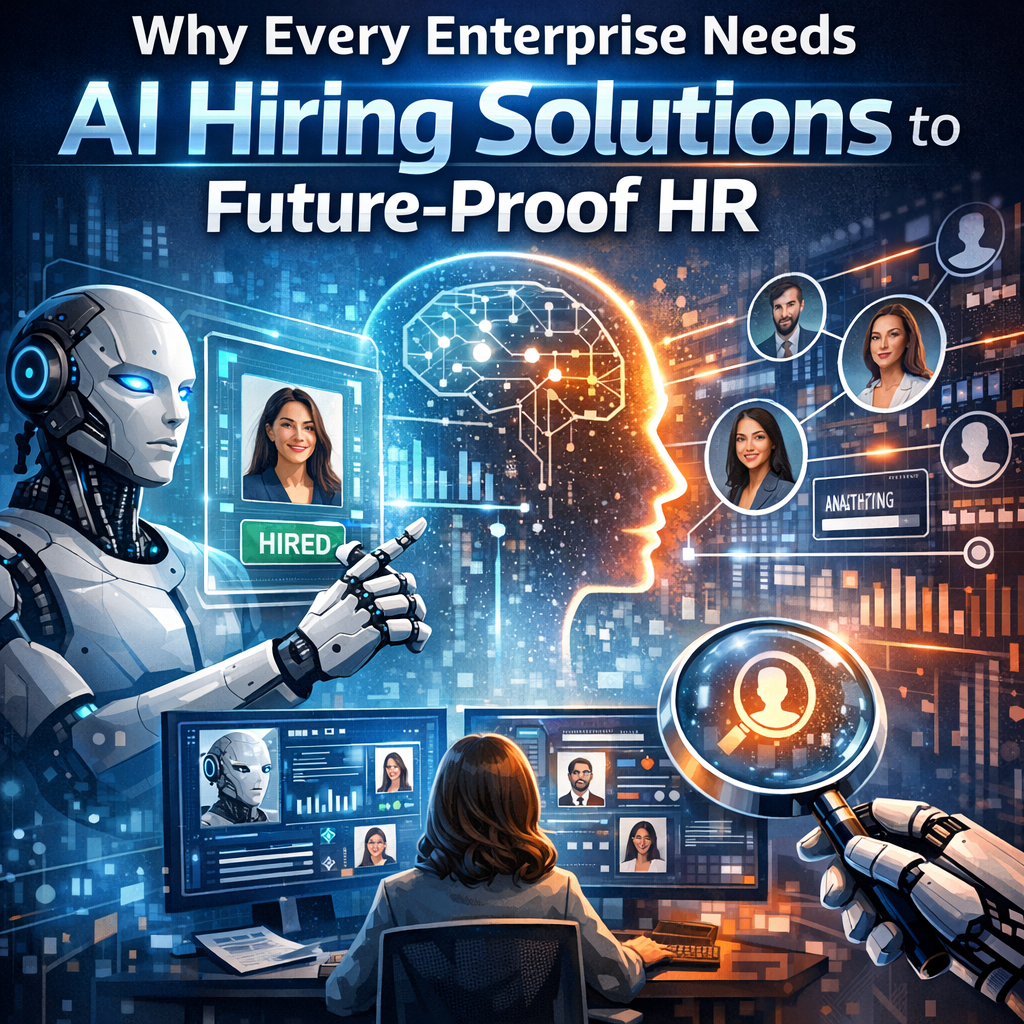
Why Every Enterprise Needs AI Hiring Solutions to Future-Proof HR
Future-Proofing Your HR Strategy: Why Every Enterprise Needs AI Hiring Solutions
Hiring needs rarely stand still. New roles emerge, skill requirements shift, and candidate expectations evolve—often faster than traditional recruiting processes can keep up. For large organizations, these changes can make it difficult to fill positions efficiently while delivering a consistent, fair candidate experience.
AI hiring solutions can help enterprises respond to that complexity. By using artificial intelligence to support tasks across recruitment, HR teams can reduce repetitive work, gain useful insights, and focus more attention on decisions that benefit from human judgment.
What AI Hiring Solutions Can Do
AI hiring solutions use technologies such as machine learning and natural language processing to assist with recruitment activities. Depending on the platform, they may help organizations:

- Sort and organize applications
- Match candidates to role requirements
- Automate interview scheduling and routine communications
- Analyze recruiting data and identify process bottlenecks
- Support workforce planning by highlighting emerging skills needs
These tools are not a substitute for recruiters. Their value lies in helping teams manage high-volume tasks and surface relevant information, so people can spend more time evaluating candidates thoughtfully and building relationships.
Why Enterprises Need a Forward-Looking Approach
Managing scale and complexity
Enterprise hiring often spans multiple departments, locations, and job families. Each team may have different needs, while candidates expect a clear and consistent process. Manual workflows can become difficult to coordinate as hiring volume grows.
AI tools can help standardize parts of the process, such as application review workflows or candidate updates. With well-designed systems, recruiters can manage larger talent pools without relying on disconnected spreadsheets and repetitive administrative work.
Improving speed without sacrificing care
Slow hiring can lead to missed opportunities. Strong candidates may accept another offer while an organization is still arranging interviews or reviewing applications. Automation can reduce delays in routine steps, including scheduling and status updates.
The goal is not simply to hire faster. It is to remove avoidable friction while preserving meaningful conversations between candidates and hiring teams. Timely communication and a transparent process can make a significant difference to the candidate experience.
Adapting to changing skills needs
Many enterprises need to hire for capabilities that are changing quickly. AI-supported workforce analytics can help HR teams identify patterns in role requirements, talent availability, and hiring outcomes. These insights can inform decisions about whether to recruit externally, develop current employees, or redesign a role around transferable skills.
Used carefully, this broader perspective helps organizations prepare for future workforce needs rather than reacting only when a vacancy appears.
Responsible Use Requires Human Oversight
AI can make recruitment processes more efficient, but it can also reproduce problems embedded in historical data or poorly designed workflows. A system trained on biased hiring records, for example, may reinforce existing disparities rather than reduce them.
Responsible implementation should include clear safeguards:
- Keep people accountable. Recruiters and hiring managers should make consequential decisions, with AI serving as decision support.
- Review tools regularly. Test for uneven outcomes across groups and investigate unexpected patterns.
- Protect candidate data. Use appropriate security measures and explain how information is collected and handled.
- Be transparent. Tell candidates when AI is involved in the hiring process and provide accessible ways to request support.
- Measure what matters. Evaluate quality of hire, fairness, candidate experience, and recruiter workload—not speed alone.
These practices help organizations use technology with care while maintaining trust.
How to Build an AI-Ready HR Strategy
Introducing AI hiring solutions works best as a strategic project, not a quick software purchase. Start by identifying specific problems, such as long response times, inconsistent screening practices, or limited visibility into recruitment performance. Then assess whether AI is an appropriate way to address them.
Involve recruiters, hiring managers, IT, legal, and data privacy teams early. Their perspectives can help clarify practical requirements, risks, and responsibilities. Pilot a tool with a defined group of roles, establish a baseline, and compare results over time. Training is also essential: HR professionals need to understand what a system can do, where it can fall short, and how to challenge its recommendations.
The Future of Enterprise Hiring
AI is changing how organizations find and evaluate talent, but successful hiring will still depend on human insight, empathy, and sound judgment. Enterprises that combine responsible technology with thoughtful HR practices can build recruitment processes that are more adaptable, consistent, and responsive to both business needs and candidate expectations.
Future-proofing HR does not mean automating every decision. It means using AI hiring solutions where they add value, setting clear boundaries, and ensuring people remain at the center of the process.